WARNING: Language in this episode may not be suitable for sensitive listeners.
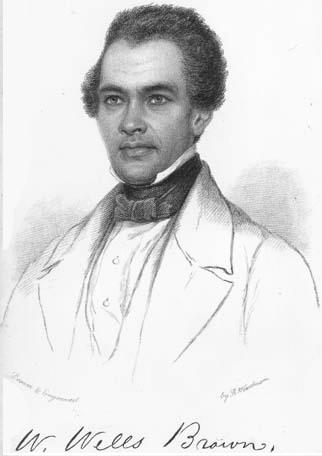
In this episode, I read from William Wells Brown’s book from 1865 titled, The Black Man: His Antecedents, His Genius and His Achievements, focusing on the first part of the author’s memoirs as he recounts his early life as a slave.
TheWholeArtNebula.com
Please consider supporting us with your generous donation.
We’re all about bridging the gaps and providing a platform for these incredible stories of artists to be heard. What I noticed, before starting this podcast, was that the average mainstream art history discussion tended to focus on just a few notable figures, but the art world is so much richer and diverse than that! TWAN is dedicated to making sure everyone has access to some of the many stories that aren’t told as often. I designed this podcast to be easily accessible to a wide audience – from scholars to everyday people. Art history education should be for everyone, and that’s what we’re here to do.
But, as we continue on this incredible journey, we’re also committed to enhancing the quality of our podcast. We want our listeners to have the best experience possible and I’ve noticed that some of our earlier episodes require a bit of sound editing, and my style of narration has evolved. I believe it’s time to elevate the audio quality to match our content. I’ve never done this on TWAN before, but that’s why I’m here, reaching out to you today – to ask for help.
With your generous donation, you’re not just supporting TWAN; you’re directly contributing to our mission. Here’s how your contribution can make a real impact:
– A $5 donation buys 50% of a short run ad to grow our audience. It helps us reach more people who may not yet know about the incredible stories we share. It’s about the price of a cup of coffee at Starbucks.
– A $25 donation, covers about 75% of our website costs for a month. The site is a crucial hub for our community, where we host our episodes and share additional content.
– A generous $50 donation covers the cost of 1 1/2 months of web maintenance, ensuring our platform is always running smoothly for you.
– And for those who can contribute $120 or more, that covers about 50% of the editing costs for one episode. This directly improves the quality of our content and ensures these remarkable artists’ stories are told in the best possible way.
And as a token of our appreciation for your support, we have some wonderful gifts to offer you:
– For a $5 donation, you’ll receive a heartfelt “thank you,” and a sticker. It’s of an abstract work I painted last year and I would love for you to have it.
– With a $25 donation, along with a “thank you” you’ll be gifted a special thank-you pack filled with buttons, stickers, a pin and more.
– With a generous $50 donation you’ll not only get you the thank-you pack but also a pair of TWAN socks to keep your feet stylish. They’re actually the same sock you’ll find at our merch store.
– And for those who can contribute $120 or more, you’ll receive the thank-you pack, a t-shirt, an art print and our deepest gratitude for helping us make a difference.
I want to express our heartfelt gratitude to all of you who’ve been supportive on this journey. Your contributions make a real impact in ensuring these stories of Black artists are heard and celebrated. Together, we’re bridging some of the gaps in art history, one episode at a time.
To make your donation and claim your gifts, please visit our website at TheWholeArtNebula.com and click on the donate button at the top. Then choose the amount you’d like to donate. There’s even space to create a different amount. All of it helps. Also, consider committing to a monthly or an annual donation to help the podcast go even further.
Your support means the world to me. Thank you for being a part of The Whole Art Nebula family, and for helping us shine a light on the brilliance of Black artists. Thank you to Addae for the banging music you provide. Thank you to ElleBeah, Henry Jones III and Kevi Yada for your participation and undying love and support.
Stay tuned for more incredible stories and enriching episodes. For the next couple of weeks I’ll be giving you more content to shed light on this fundraising campaign. Again, thank you and be on the lookout for more!
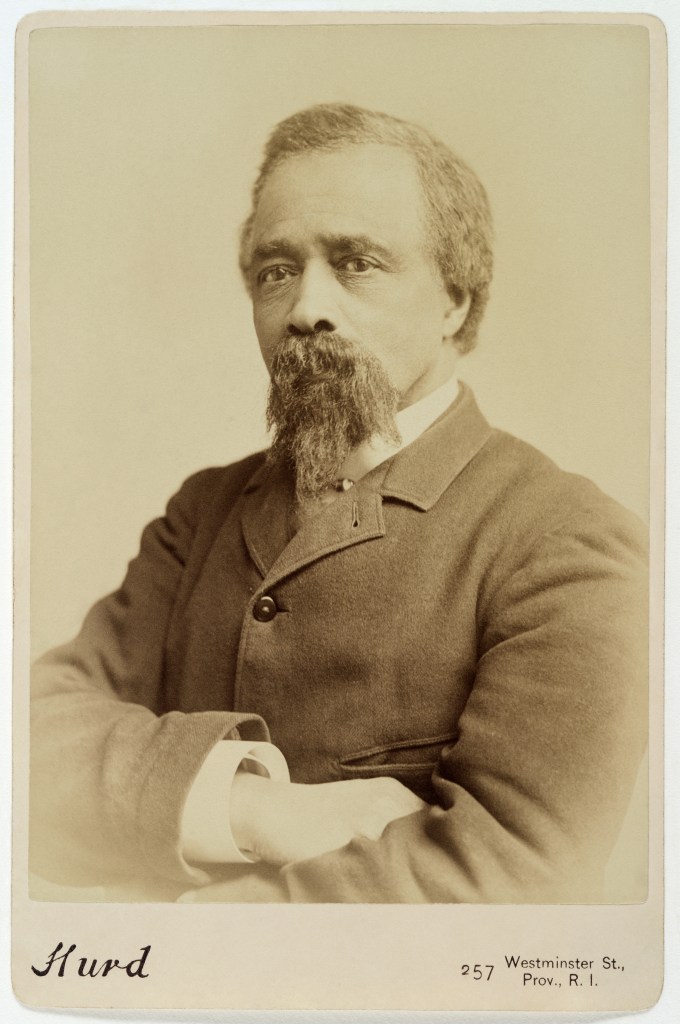
Edward Mitchell Bannister was born on November 2, 1828, in the small seaport town of St. Andrews in New Brunswick, Canada. It was known to the Passamaquoddy First Peoples as Qua-nos-cumcook. Edward’s father, also named Edward Bannister, was from Barbados, and died when the younger Edward Bannister, was either 4 or 6 years old. The tragedy created both an emotional and financial hardship on the family, and forced young Bannister’ s mother, Hannah Alexander Bannister, a woman of Scottish descent, but born in St. Andrews, to raise young Edward and his older brother, William, by herself.
Because Bannister was born in Canada, like Robert S. Duncanson (who we covered previously), he didn’t experience the same oppression and deprivation that many African-American children had to endure. He attended a village grammar school and received a far better education. This is according to William Wells Brown, who, before Bannister was nationally recognized, wrote his first biography in 1863.
Hannah Bannister, William and Edward’s mother, not only pushed Edward in his school studies, but she also nurtured his natural artistic abilities. So, while still a boy, he gained a bit of a local reputation for his crayon portraits he’d created. However, sometime, in his teens, Edward and William’s mother passed away. Poor thing. And after her passing, William moved to Boston in the United States, because he wasn’t in a position to care for his younger brother, Ned. That’s what Edward was known as by the people close to him.
This must’ve been incredibly stressful for both boys, but especially for poor young Ned. Fortunately, though, he was taken in by a wealthy attorney named, Harris Hatch. Bannister lived in an attic bedroom on the family farm and was assigned specific chores. With this arrangement, Bannister also gained access to the attorney’s well-shelved library where he found inspiration in two family portraits.
I wasn’t able to track down who these two people were, but… Oh, Bannister loved these portraits. He reproduced them every chance he got – and everywhere he could. He drew them on barn doors, he drew them on fences – any flat surface that wouldn’t get him into trouble. He drew them.
It’s not clear when Bannister left the Hatch home, but it’s speculated that he left in his late teens. At first, he became a cook, but later became a sailor, visiting Boston and New York often.
During these visits, he explored libraries, museums, and galleries, which greatly expanded his appreciation for art. Of course, he gravitated to these places. He loved art. He had natural raw talent. And these places just fed his desire to learn to master the craft, but, he couldn’t find a mentor. So, to stay in Boston and pursue his passion for art, Bannister became a barber in 1853– and later, a hairdresser.
It was here, in the salon, where he would meet his future wife, Madame Christiana Carteaux. She was a successful African-American businesswoman and owner of the salon where Bannister worked. Born in North Kingston near Providence in 1822, Carteaux was sought after my many socialites in the area because of her elegance and intuitive understanding of their needs. Carteaux and Bannister struck up a close friendship and were married by 1857.
After dabbling in styling women’s hair in the latest trends and tinting portraits, a side gig he’d taken on after arriving in Boston, he eventually shared studio space with portrait artist, Edwin Lord Weeks, who later became known for his works featuring subjects from India.
I did get a chance look at some of Edwin Lord Weeks works. Out of curiosity. I found out that he was classified as an Orientalist. I actually didn’t know that was a thing. But his work is beautiful. I love what he did with light. H is background included wealthy tea merchant parents who traveled a lot. So, Weeks’ paintings, I think, are more interesting because he created images, most American would have never see in person. Snapshots of life from a far different culture and now, time period.
(Act II)
Bannister’s paintings, in contrast, primarily drew inspiration from biblical stories and themes, and were featured in group exhibitions at the Boston Art Club and Museum. In addition to biblical scenes, he painted portraits, local landscapes, and scenes from history.
Most of his works from this time period have been lost. One such piece, painted before 1855, is titled “The Ship Outward Bound” and belonged to Dr. John B. Degrassi, the first Black physician in Boston and a close friend of his. Bannister also created portraits of Degrassi in 1854 and his wife in 1852. In 1857, he completed a landscape titled “Dorset, New Hampshire.”
Fortunately, at the time, Boston had a strong abolitionist presence, which greatly benefited Bannister. This support allowed him access to educational institutions like the Lowell Institute. The Lowell Institute was established in 1836, with a mission to provide knowledge to people in the area, regardless of gender, race, or economic status. They actually still exist today, and have achieved all this by organizing free public lectures and educational programs.
Bannister also had opportunities to exhibit his work in prominent art associations. And like I mentioned, during the 1850s, Boston’s commitment to abolitionism grew, with many supporters and financial backers of John Brown living there. For those who may have forgotten, John Brown was a White abolitionist who organized and led a raid and was later hanged in 1859, for that raid on Harpers Ferry, Virginia, in an attempt to end slavery.
One of the Black abolitionists focused on showcasing that Black individuals could excel in the arts was William Wells Brown. When I’m referring to him, I’m just going to address him by his full name so that you don’t confuse him with John Brown. William Wells Brown had escaped from slavery and moved to Boston when he was 19-years-old. He adopted the name, “Wells Brown” from the Quaker couple who took him in after his escape.
In his book titled “The Black Man: His Antecedents, His Genius, and His Achievements,” published in 1863 by James Redpath (the first biographer of John Brown), William Wells Brown also included an account of Bannister’s life and accomplishments.
The book featured profiles of about 50 Black men and women, including Nat Turner, the leader of a slave uprising in Virginia; writer Alexander Dumas; mathematician Benjamin Banneker; educator Charlotte Forten; and Captain Andre Callious, who led Black troops in an attack on Confederate forces at Port Hudson in New Orleans. The book also highlighted two Black artists, Edward Bannister and sculptor, Edmonia Lewis. The overview of Black history in this book surprised and captivated a lot of people.
Including me! So, I was thinking about reading this book on the podcast later, maybe to add some interesting content while I create the next episode – especially since I sometimes have big gaps in between each episode…We’ll see…
William Wells Brown offered a detailed description of Bannister, who had his studio in Boston’s Studio Building at the time. By the way, the Studio Building was built in 1861, and used to be a prominent building on Tremont Street that had a lot of artist studios, theater companies and other businesses. It burned down in a fire in 1906.
William Wells Brown described Bannister as “spare-made, slim, with an interesting cast of countenance, quick in his walk, and easy in his manners.” Also, William Wells Brown provided insights into several of Bannister’s artworks. One of these was a landscape painting, another depicted a genre scene titled “Wall Street at Home,” featuring “an elderly gentleman seated in his comfortable chair, boots off, and slippers on, avidly reading the latest news.” Brown also discussed another of Bannister’s works, a historical piece titled “Cleopatra Waiting to Receive Marc Anthony.”
At the time the book was published, Bannister was 35 years old. The book’s inclusion of him alongside outstanding Black men and women brought him to the attention of numerous individuals, particularly in Boston, who might not otherwise know him.
In that same year the book was published, President Abraham Lincoln responded to Frederick Douglass and other African-American leaders’ demands, granting Black men the opportunity to fight as soldiers against slavery. Both Bannister and his wife were active in the fight for equal pay for Black soldiers serving in the Union army. In Massachusetts, Governor John Andrews was authorized to organize Black regiments, and Black men eagerly joined, only to find out that Union Army leaders were offering them $10 a month with a $3 deduction for clothing, whereas white soldiers received $13 a month plus an additional $3.50 for clothing. This unequal pay scale was justified by labeling Black soldiers as laborers rather than fighters.
So, just a quick summary here: White soldiers got more money and a uniform stipend, while Black soldiers got less money plus were docked pay to cover uniform costs.
When they discovered this disparity, the Bannisters immediately took action to raise funds to bridge the gap. With Governor Andrews’ approval and his summoning of the state legislature to address the issue, Bannister’s wife organized a substantial effort to sell valuable items obtained from prominent Bostonians, including many of her clients. Bannister oversaw the decoration of the hall and the arrangement of tables and items, which were either sold directly or auctioned. This initiative swiftly generated about $4,000 and drew attention to the issue of unfair pay, ultimately prompting Congress to act on equalizing the pay.
The Bannisters relocated to Providence, Rhode Island, in 1870. Edward already had friendly connections with Providence artists from his time in Boston studios and galleries. One of these artists was Connecticut born portraitist, John Nelson Arnold, Bannister’s friend since their days at the Lowell Institute. But Edward wasn’t the only connected one. His wife, Christiana, also had strong ties in Providence, including relatives and prominent socialites who got their hair done in her salon.
The move to Providence allowed Bannister easy access to the rural and wooded landscapes crucial for Barbizon painting. For the most part, The Barbizon School was Bannisters signature style. Originally, its pioneers of the Naturalist landscape painting movement, gathered in the town of Barbizon near the Forest of Fontainebleau outside Paris. The artists were diverse in their backgrounds and styles, and they shared a passion for painting outdoors, elevating landscapes as independent subjects. The forest’s rugged beauty inspired artists like Corot, Rousseau, Millet, Renoir, and Manet. In contrast to Neoclassicism’s idealized depictions (like those of the Hudson River School), these artists approached painting naturally, truthfully representing what they observed in the countryside’s colors and forms.
Bannister set up his studio in the Woods Building, where his friend, John Nelson Arnold and other artists had their studios. As he focused more on landscapes and scenes of the Narragansett shore, Bannister gradually reduced the amount of religious and historical works he produced.
(Act III)
About four years after moving to Providence, Bannister went on a sketching trip to William Goddard’s farm near Potowomut. I believe this land is now a state park. It was during this visit, Bannister was drawn to a cluster of oak trees and created the painting, “Under The Oaks.” Both he and fellow artists who visited his studio considered this to be his finest and most exceptional work.
In Providence, the artistic community was well aware of the upcoming 1876 United States Centennial Exposition in Philadelphia, which promised to showcase the most extensive collection of art ever seen in the nation. This event marked a time when American museums were just beginning to emerge. Alongside renowned European artworks, the exposition would feature pieces from America’s early masters like Benjamin West and John Singleton Copley, as well as contemporary American artists.
Bannister submitted “Under The Oaks” to a regional jury in Boston, and it was chosen as their top entry. The Boston Traveler’s art critic hailed it as “the greatest of its kind by an American artist.”
At the Centennial Exhibition, Bannister’s painting competed with notable works by Albert Bierstadt, J.F. Cropsey, and Frederick E. Church. Identified as “Number 54 – Under The Oaks – E. M. Bannister,” it earned the bronze medal, the most prestigious prize for oil painting at the event. This medal was recognized as the highest painting award, as reported in the Providence Journal on January 11th, 1901.
In his recollections, George W. Whitaker, another Barbizon School artist and close friend of Bannister for three decades, recounted Bannister’s personal experience at the Centennial. When he saw his painting in the catalog, Bannister was so excited. His childhood dream was coming true! Then he located his work, which was displayed prominently, and this made him so proud. Later, Bannister said:
I learned from the newspaper that “54” had received a first prize medal, so I hurried to the committee rooms to make sure the report was true. There was a great crowd there ahead of me. As I jostled among them, many resented my presence, some actually commenting within my hearing and in most petulant manner: what is that colored person in here for? Finally, when I succeeded in reaching the desk where inquiries were made, I endeavored to gain the attention of the official in charge. He was very insolent. Without raising his eyes, he demanded in the most exasperating tone of voice, “Well what do you want here anyway? Speak lively.” ” I want to inquire concerning number 54. It is a prize winner?” ” What’s that you?” said he. In an instant my blood was up; the looks that pass between him and others in the room were unmistakable. I was not an artist to them, simply an inquisitive colored man. Controlling myself, I said deliberately “I am interested in the report that Under The Oaks has received a prize. I painted the picture.” An explosion could not have made a more marked impression. Without hesitation he apologized to me, and soon everyone in the room was bowing and scraping to me.
Bannister’s African-American heritage was openly acknowledged, and his achievements were recognized by his community. Two African-American reporters reviewed his award-winning painting in the Christian Recorder of the American Methodist Episcopal Church. FYI, the Christian Recorder is still in publication. On its website, it says it’s the oldest existing African American newspaper in the United States.
One review, authored by Robert Douglass Jr., a skilled Philadelphia artist known for portraiture and miniatures, praised “Under The Oaks” as a serene pastoral scene featuring a shepherd and sheep beneath a splendid cluster of oak trees. He further noted that the painting was highly admired and expressed his delight that it had earned a medal. Douglass Jr. drew parallels between it and the masterpieces of John Constable, the renowned English landscape painter.
Following its award, “Under The Oaks” was sold through art dealers Williams and Everett to a Boston resident named Mr. Duff for $1,500, a good amount of money for a painting at the time. That would be about $54,000 today. Bannister’s share of the proceeds was $850, about $31,000 today.
In line with the typical dealer-artist relationships of that era, Bannister was at first, unaware of the painting’s buyer. It was only years later that he accidentally discovered where it was and received permission to view it. He found it proudly displayed in the front hall of Mr. Duff’s residence, beautifully hung on a French landing with an easy chair positioned for Duff to contemplate its tranquil beauty each morning before heading to his office. Regrettably, neither the painting nor the medal awarded to Bannister can be located today.
Bannister’s old friend, Whitaker proposed uniting artists, professionals, amateurs, and art collectors in a club. They initially met in Bannister’s studio, focusing on issues with dealers who charged high prices and provided little return. Exhibitions and sales opportunities were scarce.
After two years of discussion, Bannister, Whitaker, and self-taught landscape artist, Charles Walter Stetson, invited a larger group of artists to join them in February 1880. They considered establishing a gallery and sales room but opted instead for an inclusive art club, welcoming artists, amateurs, and art enthusiasts, including those in music and literature. The idea received a lot of community support.
The Providence Art Club was officially founded in, Norwegian artist, Eimerich Rein’s studio on February 19th, 1880. Bannister was the second to sign the agreement, following J. S. Lincoln, the elected president. Founding members included Eimerich Rein, John Nelson Arnold, George Whitaker, Charles Walter Stetson, Sydney Burleigh and Rosa Peckham. Bannister served on the executive committee for many years.
As a professional artist, Bannister primarily painted: serene blue-gray skies with breezy white cumulus clouds in the late afternoon, the rolling Rhode Island landscape, and the picturesque Narragansett dunes and shores. Initially, his style reflected the influence of Barbizon artist, William Morris Hunt, his revered mentor. Over time, he embraced his unique vision of nature, moving away from the Barbizon style.
His paintings consistently achieved their impact through simplicity, patience, and careful observation of nature. In contrast to the imaginative and dreamlike landscapes of artists like Robert Duncanson and Frederick Church, Bannister’s work reflects his enduring admiration for nature’s gifts while exuding a tranquil, balanced, and steadfast quality, much like his own personality.
Whitaker, who had studied Barbizon painting in France under the guidance of Millet and other masters, fondly reminisced about a trip he and Bannister took to a significant Barbizon painting exhibition in New York City:
There my friend was in his element. As we walked from picture to picture, talking more earnestly than we were aware, we noticed we were being followed by a stately old gentleman of the old school who soon introduced himself, giving his name and saying he was in officer of the Metropolitan Museum and would we, after doing this exhibit, be his guest at the museum? I am sure he had been attracted by Bannister’s talk and actions – namely, his hands, feet, body, and head, so enthusiastic did he become. We accepted and were royally entertained. It was one of the greatest treats I ever enjoyed and reminded me of a day spent with George Inness in Paris 25 years ago.
One intriguing aspect of his friend that puzzled Whitaker was that although Bannister was an experienced seaman and spent much of his time sailing, he didn’t concentrate on marine paintings. For more than 25 years, he sailed his small yachts in Narragansett Bay and Newport Harbor. Whitaker noted, “I have had the pleasure of being in his company on his boat for weeks at a time, and I fancy that here he made his mental studies of cloud… land… these were days when his cup of joy was full.”
Bannister received regional honors as well. At the Massachusetts Charitable Mechanics Association annual exhibit, a significant Boston show, he earned a bronze medal in 1878 and silver medals in 1881 and 1884. Notable art collectors, including Isaac C. Bates, Eliza Radeke, and H. A. Tillinghast, purchased his paintings, and these patrons were associated with the Rhode Island Museum of Art.
Despite the recognition, Bannister lamented his lack of formal training. In a letter to Whitaker late in life, he expressed his frustration, saying, “I cannot do all that I would like in art due to my lack of training, but with God’s help, I hope to deliver the message entrusted to me.”
Unlike the meticulous detailing seen in Hudson River School paintings, Bannister’s art focuses on massive shapes like trees, mountains, rocks, and trails. These shapes emerge through the sharp interplay of light and shadow, often emphasizing black and white values over color relationships. As Whitaker noted, “He knew the value of deep shadows as a foundation for his painting. His color palette was subdued, playing with shades of gray.”
In a work titled, “Approaching Storm,” a departure from his tranquil landscapes, you can see a man urgently seeking shelter from a vantage point atop a nearby hill. The path he travels is in the foreground, with wind-tossed trees in the middle distance. The left hills and the sky above form the background, creating a relatively narrow spatial depth. When “Approaching Storm” is turned upside down, it becomes evident that the foreground, trees, and hills blend into one large silhouette against which the man stands out.
In his landscapes, Bannister conveyed mood and emotion through his own observations, using a sketchy brushwork style. This unfinished approach had the spontaneity of John Constable and some Barbizon painters, setting it apart from the controlled finish of Hudson River School artists.
Bannister was intrigued by the unpredictable aspects of nature—how clouds, light, and trees behaved in changing weather conditions. “Approaching Storm” exemplifies his fascination with these natural phenomena. His best works found unity in their underlying feeling and atmosphere, skillfully balancing elements, rather than emulating the constructed landscapes of Claude Lorrain or later artists like Cezanne. Bannister liked to capturing nature’s imperfections. He derived his colors directly from his subjects, resulting in muted earthy tones.
In his later years, Bannister faced challenges as changing tastes made it increasingly difficult to sell his work. This posed more financial hardships for his family. Eventually, his health declined, forcing him to give up sailing, and lapses in memory made simple walks unsafe. Mentally and physically he deteriorated. On the evening of January 8th, 1901, he passed away from a heart attack during a prayer meeting at the Elmwood Avenue Free Baptist Church.
The artists in Providence honored Bannister’s grave with an 8-foot-high boulder bearing a bronze palette and a pipe, symbolizing his love for art. Arnold, who understood the challenges Bannister had overcome to achieve his artistic recognition, found this tribute somewhat inadequate.
(Conclusion)
John Nelson Arnold, a respected portraitist, believed that Bannister’s artistic legacy would endure. He observed that Bannister approached nature with a poet’s sensibility, capturing skies, rocks, trees, and distances on canvas with both vigor and poetic beauty. Arnold predicted that over time, Bannister would be recognized as one of the leading American painters.
In a time when American painting lagged behind European art, Arnold couldn’t foresee the eventual rise of the uniquely American Hudson River School, which celebrated the nation’s untamed wilderness and vast landscapes. Despite witnessing the Civil War and the end of slavery and seeing his Black friend gain national recognition, Arnold couldn’t predict that persistent racial prejudice would lead to Bannister’s omission from 19th-century American landscape painting histories.
Today, Bannister’s significance extends beyond his paintings. His life serves as a testament to the fact that America wasn’t always consumed by intense racism. His achievements highlight the contributions Black people have made in a democratic society, enriching the lives of all its citizens.
Source:
Bearden, Romare and Henderson, Harry (1993). “A History of African-American Artists: From 1792 to the Present,” Pantheon
Matthew Baker was born on December 10, 1921, as Clarence Matthew Baker in Forsyth County, North Carolina to Clarence “Mac” and Ethel Viola Lash Baker. In the 1920s, Forsyth County, North Carolina, was predominantly known for its agricultural heritage and the cultivation of tobacco with tobacco shaping the local economy and culture. The county was characterized by vast fields of tobacco crops and the presence of tobacco processing facilities.
Clarence (the son – let’s just go ahead and refer to him as Matthew now, since that’s what he’ll come to be known as for most of his life) had an older brother, John Franklin Baker. I also read that Ethel and Clarence (the parents) had an older daughter who had passed away, maybe even before Matt was born. However, sometime between 1922 and 1924 the family left Forsyth County and relocated to Pittsburgh, Pennsylvania, where a third brother, Charles Robert Baker, was born. About a year later, on December 15, 1925, ten days after his 30th birthday, Mac (their father) passed away. In my research, I couldn’t find his cause of death, but Matt was only four years old. And while still very young, he suffered a case of rheumatic fever, which damaged his heart.
Five years later, in 1930, Ethel married a man named Matthew Porterfield Robinson. If you’re keeping track this is the third Matthew in the story. First there was Ethel’s first husband, Clarence Matthew Baker, then her son – also Clarence Matthew Baker, and now her second husband, Matthew Porterfield Robinson. Anyway, eight years later, she gave birth to their surprise baby – the only one she and her second husband had together, a boy named Fredrick Leander Robinson.
Later, Matt Baker graduated from high school around 1940 and later moved to Washington, D.C., where he initially worked for the government. Now, for historical context, keep in mind, this is happening during World War II. Stepping away from this government job (whatever it was), in 1943, he enrolled at the Cooper Union School of Engineering and Design in Manhattan, New York. This is the same year that American film executives agreed to permit the US government’s Office of War Information to censor American films. It’s also the same year that the Italian submarine called the Leonardo da Vinci, sinks a Canadian Pacific liner called the RMS Empress of Canada, off the coast of Sierra Leone.
Just a side note here, because I think it’s important for you to take in what Matt Baker looked like to get a better sense of who he was. He was described as a captivating presence, standing tall with an aura of strength and vitality – despite his health issues. He was considered a handsome man who often adorned a gentle, closed-mouth smile and a gaze that reached into your soul. He seemed intense. He had a beautiful dark-coffee complexion and got a lot of attention wherever he went. Muy guapo.
Even in a business known for its rough edges and casual atmosphere, Baker exuded elegance and sophistication. He was a man who understood the power of appearance, always donning impeccably tailored, broad-shouldered, double-breasted suits that accentuated his stature. His sense of style extended to his accessories, with a collection of at least four fedoras in rich shades of brown, black, green, and maroon, each carefully chosen to perfectly complement his ensemble.
He lived in the vibrant neighborhood of Harlem, and though the details of his personal life remained veiled in mystery, it was evident that he lived with an air of prosperity and independence and with his yellow convertible coupe, he embraced the freedom of the open road, and turned a lot of heads. Remember, this is the early 1940s.
After his studies, Baker joined S.M. Iger Studios in 1944 as a background artist. His first published work came in 1944’s Jumbo Comics #69, where he penciled and inked a “Sheena, Queen of the Jungle” story.
“Sheena, Queen of the Jungle” was a fictional comic book heroine, beloved for her daring exploits in the untamed wilderness. She holds the distinction of being the first female character to star in her own comic book series, making her debut in 1941 (cover-dated Spring 1942), a remarkable achievement preceding even the iconic Wonder Woman (cover-dated Summer 1942).
Here’s her backstory; Sheena was born an orphan and raised amidst the mysterious depths of the jungle, Sheena possesses extraordinary skills that allow her to not only survive but thrive. Her deep connection with wild creatures enables her to communicate effortlessly with them AND she is a master of combat, wielding knives, spears, bows, and ingeniously crafted weapons with unparalleled prowess. Her captivating adventures frequently involve enthralling encounters with nefarious slave traders, intrepid White hunters, indigenous Africans, and the untamed beasts that roam the wilderness.
So… This early opportunity gave him a platform to showcase his talent and gain valuable experience in the comic book industry.
Baker’s career took off in the 1940s when he started working for quality comic book publishers like Fox Features Syndicate (also known as Fox Comics and Fox Publication) and St. John Publications. He became known for his exceptional skill in depicting the human form, particularly his mastery in drawing women with elegance and grace.
Another side note: For a VERY long time, even now, comic books have received flak for their less-than-stellar portrayal of women, leaving us with a gallery of heroines that seem to have emerged from the wildest imaginations of hormonal teenage boys. We’re talking about scantily clad super vixens with gravity-defying assets and bodies that make physics question its existence. While there’s a heated debate about the industry’s alleged progress in tackling outdated sexist imagery – like today’s comic books give their female characters more realistic waist proportions, in general – still, one thing is clear: comic books still have a marathon ahead of them, concerning female imagery.
I can go deeper into that, but I’ll spare you.
I said all of that, because I wanted to point out that Baker’s style is often referred to as, “good girl” art, characterized by his attention to detail and his ability to capture the beauty and sensuality of female characters, in a way that was different from his fellow comic artists. His compositions often featured dynamic angles and lighting, creating visually striking panels. He believed in portraying women as strong and confident, challenging traditional stereotypes really prevalent in the comic book industry at the time.
His most iconic creation, “Phantom Lady,” became a sensation in the comic book industry. In case you were curious, “Phantom Lady,” is about Sandra Knight, the daughter of Senator Henry Knight, and is a Washington D.C. socialite turned crime-fighting Phantom Lady. While lacking superhuman abilities, she is a formidable fighter and wields a blacklight ray to cloak herself in darkness and vanish from sight.
Baker’s artwork on the “Phantom Lady” series showcased his mastery of the “good girl” style and established him as a trailblazer in depicting powerful and complex female characters. He also worked on other titles such as “Sky Girl” and “Canteen Kate,” demonstrating his versatility as an artist.
Baker faced significant challenges as an African-American artist during this time, of course. This was the era where The Montford Point Marines were established by the U.S. Marine Corps as the first Black men accepted into a segregated training camp.
Baker is also doing all this innovative work during the time when, tragically, the Detroit Race Riots happen, claiming the lives of approximately 34 Black residents. For a span of five days, the community witnesses harrowing clashes between Black community members and the police department, marked by intense violence and unrest.
Beyond the need to overcome racial barriers and limited opportunities in the industry, Baker’s work was also subject to criticism and controversy, particularly with the publication of Dr. Fredric Wertham’s book, “Seduction of the Innocent.” Back in the 1950s, the German-American psychologist, Fredric Wertham, clearly hated comics. He claimed to have cracked the code of the century in his 1954 book, ‘The Seduction of the Innocent’, where he boldly declared that there was a connection between violent comics and the mischievous antics of our precious juvenile delinquents. It received so much attention that its publication impacted the perception of comic books and led to major increased censorship.
So, just as an update to the book ‘The Seduction of the Innocent’:
Following the unsealing of Wertham’s manuscript collection at the Library of Congress in 2010, Carol Tilley, a librarian and information science professor from the University of Illinois, embarked on an investigation of his research. Her findings revealed that Wertham’s conclusions were largely groundless. In her 2012 study, Tilley concluded that Wertham had manipulated, exaggerated, compromised, and even fabricated evidence, particularly regarding his supposed clinical research.
Tragically, Baker’s career was cut very short. In 1957, he suffered a stroke that affected his ability to work. Two years later, on August 11, 1959, at the age of 37, Baker passed away from a heart attack, most likely due to complications from his earlier rheumatic fever.
Despite the brevity of his career, Baker left an indelible mark on the comic book industry. He challenged norms, shattered stereotypes, and paved the way for future generations of diverse artists. His artwork continues to inspire and influence contemporary creators, and he is recognized as a pioneer. Baker’s contributions to the medium, particularly in depicting strong and empowered women, remain significant and have had a lasting impact on the world of comic art.
His work can still be found in various comic book collections, both in print and online. His iconic series, “Phantom Lady,” is highly regarded and sought after by collectors and enthusiasts alike.
The information for this podcast episode on Matthew Baker was sourced from various articles and resources, including CBDF.org, Black Past, Sell My Comic Books, Black Then, and other reputable sources. These materials provide valuable insights into Baker’s life, career, and contributions to the comic book industry.
My guest, Kevi Yada, joins me this time, to talk about one work by Minnie Evans. If you haven’t listened to our episode on Minnie Evans, I highly recommend it.
Minnie Eva Jones was born on December 12th, 1892 in a log cabin in Long Creek, North Carolina. Now, just to give you a little perspective, in the 2020 census, the unincorporated community of Long Creek had a population 277. Minnie’s mother, Ella Jones, was 14 years old when she gave birth to Minnie. A child herself. Minnie’s father, George Moore, was also very young – though I couldn’t find a source that specified exactly how young… But he wasn’t really up for the responsibility and abandoned his little family.
Ella, Minnie’s mother, worked as a domestic at the time and when her infant was 2 months old, Ella took Minnie to live with her mother, Mary Jones, in Wilmington, North Carolina. It’s Mary, Minnie’s grandmother who Minnie would call, “Mama.” Her biological mother, Ella, became more of a sister figure to her. Minnie’s great-grandmother, Rachel, who lived with them until Minnie was 7, traced their ancestry back to Rachel’s great-grandmother, Moni, who’d been brought to North Carolina from Trinidad as a slave.
Minnie began school at five years old and attended until she was in the sixth grade – leaving school to help earn money for her family. But while she was in school, she loved studying history and Greek mythology. She said she would learn things and forget things in school – perhaps like the rest of us. She said, “I did not love anything but history, which I would never forget. I would love to read about the Gods. I would always love to watch the moon and stars.”
As a child Minnie experienced very intense vivid dreams that disturbed her sleep and made her prone to waking dreams and visions by day. And she often heard voices. She is quoted as saying that she couldn’t recall a night she slept without having dreams. Her waking dreams, however, created recurring hallucinatory experiences that led to a confused sense of reality. According to author and art historian, Gylbert Coker, there were times when Minnie could barely distinguish between dreams and visions, as well as between dreams and wakeful experiences. This continued throughout her life, though with varying intensities. The waking dreams were frequently images of prophets and religious figures, real and mythical animals, flowers, plants and faces. She wasn’t completely out of touch though. She was very aware that her experiences were unusual and was cautious about letting others know about this phenomenon.
When she left school, she worked as, what was called, a “Sounder” – gathering shellfish from the sound in Wrightsville, North Carolina which she sold door to door.
If you don’t know what a sound is, it’s a smaller body of water typically connected to a larger sea or ocean.
Minnie met and married, 19-year-old, Julius Caesar Evans, four days after her own 16th birthday. But Minnie was not of legal marrying age, so she wrote that she was 18 on the marriage license. The couple would later joke about this throughout their marriage. Minnie gave birth to three sons – David Barnes, Elisha Dyer and George Sheldon – after the New York millionaires who visited the Pembroke estate.
Minnie’s husband, Julius, worked as the valet for Pembroke Jones, a wealthy financier and socialite – while Minnie, employed on the estate as well, work as a domestic. After the death of Pembroke Jones, his widow remarried in the year, 1919 and moved with her new husband, Henry Walters (son of the founder of the Walter Art Gallery in Baltimore), to an estate called, Airlie where the Evans continued working for the family. The 150 acres were developed into expansive Gardens and opened to the public in 1943, five years after the death of Mrs. Walters. Minnie worked as the gatekeeper, collecting admission for visitors until she retired in 1974.
She didn’t start drawing until she was 43 when a voice told her she must “draw or die.” On Good Friday, 1935, Minnie unknowingly embarked on her new passion, and created her first drawings – two small pictogram-like works. Both are now in the collection of the Whitney Museum of American art.
In 1940, she began a series of pencil and crayon drawings, most of them measured to be about 7”x 5.” She carried them in her purse for many years. These works she created acted as talismans for her. She said that she kept them physically with her, because they relieved her from the emotional tension of her visions. These abstracts worked as protection from her visions while they did not specifically address them.
Nathan Kernan, in his essay titled, “Aspects of Minnie Evans,” stated, “Evans turned to art as a means of exercising the crippling power of her dreams, somewhat in the way the still more desperate Antonin Artaud drew his gris-gris of 1943 to 1944, which had a curative, protective, offensive function against the demons assailing him.”
In the event you don’t know what a gris-gris is, it is a charm or an amulet worn as protection against evil or to encourage good fortune. You’ll especially find this term used among those who practice Voodoo. However, many other spiritual practices around the world have their own term for this type of object. Think of the Italian Mano Figa or the ancient Grecian Evil Eye.
Antonin Artaud’s gris-gris were described by one art historian as drawn hieroglyphs made up of crosses and other geometric lines and arranged in a repetitive symmetry. This work was compared to a description of Minnie’s early drawings from 1935 and the early 1940s and what Evans called the ancient writing that occasionally appears in her work.
I need to stop here though. I’m not sure why these art historians are comparing Minnie’s work with Artaud’s work, since Minnie’s work came first. Artaud was a White French, writer, visual artist, dramatist and poet and though I was able to view many of his drawings, I’ve not yet found anything that resembled Minnie’s early work online. Now, to be fair, I didn’t dig super hard because this was never about Artaud, but I found this comparison of her to him slightly disturbing. My only guess is that these art historians may have seen Minnie’s condition as a mental illness and compared her to Artaud who was admitted, multiple times to mental institutions.
Back to Minnie Evans…
She often said that the meaning of her work was a mystery to her. She couldn’t tell you what any of it meant and sometimes referred to the force that drove her to draw as an engine.
Her work was an automatic process, seemingly directed by outside forces. Evans once stated, ” I have no imagination. I never plan a drawing. They just happen.”
There was a 5-year gap between her first two works and her next drawing. She stumbled across her two dated drawings one day. On one she had written, “My very first.” And on the other, it said, “My second.” She had found them stuck in the pages of a magazine that she was about to toss. It was like a sign…
Minnie began drawing compulsively after that, and her family started freaking out a little and worried that she might be losing it. But they got used to it. Eventually. She gave her pictures to people who admired her work and eventually hung them up near the gatehouse at the gardens where she worked, and started selling her drawings for 50 cents each. I did a rough calculation and found that at that price, the value would be a little over $10 in today’s money.
Minnie was a big fan of symmetry. A lot of her works are vertical in format, kept within the confines of a whimsical border. She gravitated to images of buds about to flower, cocoons and butterfly shapes. It’s been suggested that possibly, that oriental rugs that Minnie probably saw and cleaned in her employer’s homes might have inspired these compositions. In fact, one photo from the early 40’s illustrating a sculptural form standing in a small room includes, in the foreground, a rug whose pattern closely resembles one of Minnie’s early drawings.
In the 50’s and 60’s, Minnie’s art began including more representational images and less abstracted ones. These were depictions of her dreams or visions with imaginative creatures and sacred buildings located in otherworldly landscapes. The dreams she illustrated were rendered by her love of ancient mythology and her favorite book of the Bible. The Book of Revelation. Of the Book of Revelation, she said “I love to read it and I love to think about it… the New Jerusalem.”
Minnie is probably best-known for her art that combines symmetrical abstraction with figurative elements. A good example might be the work I described at the top of this episode. These works portray fantastical worlds – that of serenity and usually female or of ambiguous gendered figures, rarely male – surrounded by colorful flora, fauna and abstract figures.
I’m sure it’s not a coincidence that color bursts into her work around the same time she starts working as a gatekeeper at the Airlie Gardens. A garden stuffed with flowers, leaves, birds and butterflies – just like her work. Minnie once said, “I think sometime, once upon a time, some nation what you call idolized butterflies.”
Here’s a quote about color by Minnie. She said, “And more than a dozen times I’ve seen the most beautifulest cities in the sky. Just beautiful cities of rainbow colors. Now we dreams, we talk of heaven, we think everything is going to be white. But I believe we’re going to have the beautiful rainbow colors.”
In 1961, she had her first one-person exhibition at the Artists’ Gallery in Wilmington, North Carolina, now the St John’s Museum. In the following year, she met Nina Howell Starr, a graduate photography student at the University of Florida. Nina was in her 50s at the time of their meeting and became Minnie’s pro bono, defacto, agent, selling Minnie’s work from Nina’s New York apartment. Nina encouraged and worked with Minnie from 1962 until 1984, and traveled to see Minnie frequently and was instrumental in showing Minnie’s work in New York galleries.
Minnie’s first New York City exhibition, was at the Episcopal Church of the Epiphany in 1966, followed by other modest exhibitions in 1966 and 1969.
According to the exhibition catalog, Black Folk Artists; Minnie Evans and Bill Traylor, from the African American Museum, “The first Minnie Evans exhibitions were in the 1960s – 1961, Wilmington, North Carolina and in 1966, New York. Evans came to New York on that occasion and visited the Metropolitan Museum. This inspired her to enlarge the scale of her work and to redo earlier pieces in a larger format.”
This is corroborated by Nathan Kernan in his essay, “Aspects of Minnie Evans.” In it, he states, “After she returned home influenced by the larger sizes of some of the work she had seen in the museum, Evans began to make larger works by cutting up existing drawings gluing them to board or canvas board and expanding them with the addition of new paintings.”
One of Minnie’s pieces in the Petulo Collection bears the dates 1960, 1963 and 1966 and shows seams where the work has been cut and a triangular center section inserted. Most likely, this is one of the paintings she expanded for scale.
Author, Mary E. Lyons, recalls how Nina, Minnie’s champion and agent, suggested that Minnie go back and sign and date earlier works. She said “Minnie agreed, though she had trouble estimating dates for pictures she had completed 10 years earlier. As a result, many dates are incorrect. Not all of the signatures are Minnie’s either – in the early ’60s, Minnie asked her granddaughter to sign her pictures for her.”
A small exhibition of Minnie”s work was held at the Whitney Museum of American Art in 1975. It was guest curated by Minnie’s own, Nina Starr. This was followed by retrospectives organized by the North Carolina Museum of Art in 1986 and the Wellington B. Gray Gallery at East Carolina University, North Carolina, in 1993. That show traveled to the Museum of American Folk Art in New York City in 1994. The work of Minnie Evans continues to be exhibited in modern art museums as a great contribution to 20th century art.
Minnie was also honored on May 14th 1994, when it was declared Minnie Evans day in Greenville, North Carolina.
Minnie’s husband, Julius Evans, died back in 1956. Ella Jones Kelly, Minnie’s mother, who lived with her from 1954 on, died in 1981 at the age of 102. Minnie moved into a nursing home in 1982 and on December 16th 1987, she died at the age of 95.
An older woman looks up and out to the right. A wide brimmed sun hat shades her face and covers her white hair. Her clothes are very modest. In fact, her jacket is closed with a safety pin. There is a look in her face that could be curiosity. It could be hopefulness. There is almost a smile looming behind the look that doesn’t quite reach her lips.
This is Elizabeth Catlett’s 1952 linoleum cut work titled Sharecropper, that addressed the oppressive post-slavery system that once entrapped countless Black farmworkers in the South.
Elizabeth Catlett was born on April 15th, 1915 in Washington DC, at Freedmen’s Hospital (now known as Howard University Hospital). She was the youngest of three children of John and Mary Carson Catlett. Both her maternal and paternal grandparents were born into slavery. Her father, before he passed away, taught math at Tuskegee Institute and in Washington, D.C., but he died shortly after her birth. As a child, sometimes Catlett was left with a family friend while her mother worked several jobs to support her children. Catlett once said, “I remember drawing and painting while at this lady’s house… as a very happy part of my childhood.”
She was at Dunbar High school, when she decided to become an artist and was accepted and won a scholarship to the Carnegie Institute of Technology in Pittsburgh. This was a really big deal, but after learning she was Black, CIT rescinded her acceptance. She would recall the devastation this caused, for the rest of her life. Mary, her mother encouraged her to attend Howard University and she did – in 1932. It was here, that she initially majored in design under Lois Mailou Jones, with the intent of becoming a textile designer. Her art history professor, James B. Herring once loaned her a book on African sculpture, which completely impressed her. If you recall, we spoke of James Herring several times in this podcast, particularly in the episodes on David Driskell and Alma Thomas. Catlett’s painting teacher, James A. Porter (also mentioned previously), introduced her to the work and concepts of Mexican muralists. She was so moved by this that she changed her major from textile design to painting.
Her painting teacher, James A. Porter, arranged for Catlett to get a job on the pre-WPA mural project, but unfortunately, it didn’t last. She was fired for goofing off. She said, “I was silly – I didn’t do the work I was supposed to do. The money went to my head.” Despite this, though, she graduated with honors; from Howard in 1935.
On graduating, Catlett obtained a job teaching art at a Black high school in Durham, North Carolina, while supervising art education in eight elementary schools. For all this, she was paid $57.50 a month. She was in the segregated south, but it wasn’t segregation that caught her off guard, but the insatiable, materialistic attitudes of some Black people in the community; the lack of empathy to the needs of emotionally disturbed children, and other Black educators’ who tried to quash teachers demands for better pay. She was even kicked out and forcibly removed from a teachers’ meeting where she raised these issues. This experience made her re-examine social and economic relationships and even though her salary rose to $79 a month, she split.
In 1939, Catlett began her graduate studies at the University of Iowa, partly because there was no tuition increase for non-resident students and partly because, at that time, the influential artist Grant Wood, headed the art department there. His critical attitude towards American self-righteous arrogance, expressed in his satirical and extensively reproduced paintings, “American Gothic” and “Daughters of Revolution,” impressed Catlett. Okay, let’s be honest here, “American Gothic” by Grant Wood impresses everybody. That’s why the work is so wildly famous. You might not know it by its name but, think of the husband with the eye glasses holding a pitchfork and the wife looking scornfully at him. Yes. That painting.
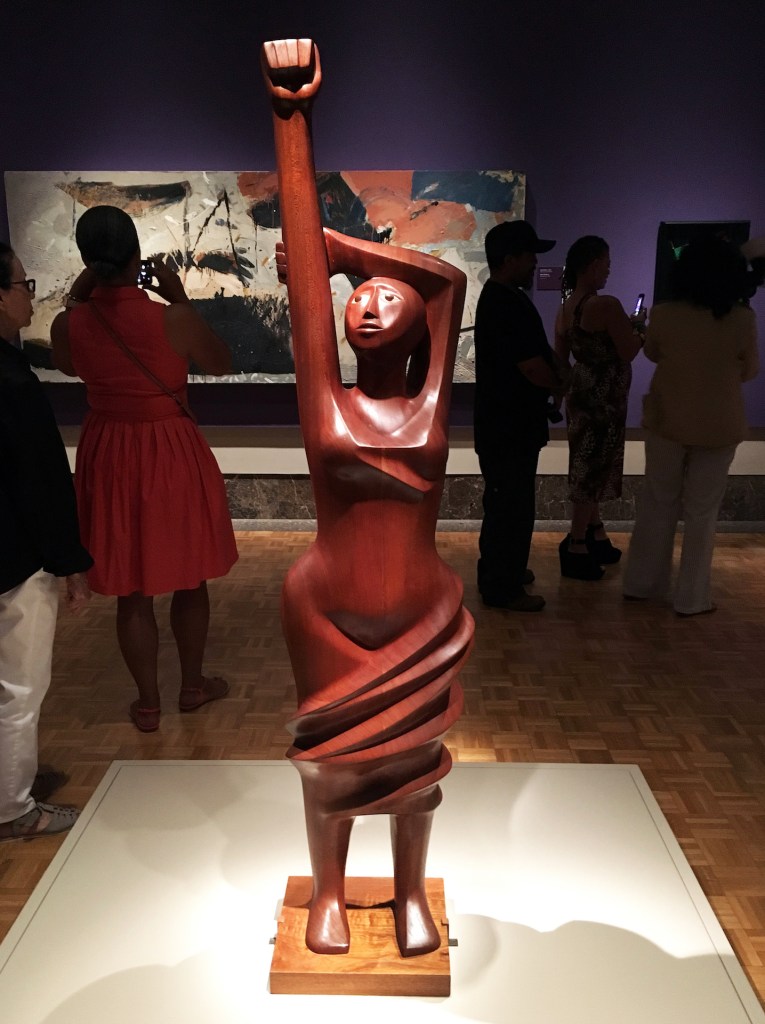
She felt Wood was demanding, but fair. He believed a master’s candidate needed to demonstrate proficiency in all major art media. So, when exploring modeling and carving, Catlett found a pleasure in the tactile awareness of the material. She said, “I like to feel something in my hands and to feel I am shaping or molding or changing something.” she explained, recalling how much she had enjoyed sewing, knitting, and crocheting. She still painted but she gravitated more towards wood and stone and was the first woman to receive an MFA in sculpture from the university.
She said later, “You might say that the United States racism formed my artistic perspective and molded my life attitude from a very early age. Grant Wood, one of the first White people that I had contact with, emphasize that we should paint what we knew most intimately… and my people have always been just that- what I know most intimately.” Catlett’s thesis was a distinctive stone statue of a Black mother and child, which took months to carve. Grant Wood loved it.
This same sculpture that delighted the hard-to-please Grant Wood, won first prize in sculpture at the 1940 American Negro Exposition in Chicago. At this exposition she met many young Black artists, which also included Charles White, who she ended up marrying. Shortly after this exposition, she was appointed as head of the art department at Dillard University, in New Orleans, where White also taught. However, the administration wasn’t taking her seriously in her quest to develop a complete art program – so she resigned.
She and Charles White moved to New York, where White studied printmaking at the Art Students League under Harry Sternberg, a New York painter, muralist, lithographer and educator. Sternberg, however, recommended that Catlett study with Ossip Zadkine – a Russian-born sculptor known for his dramatic Cubist-inspired sculptures.
Zadkine was almost destitute – a refugee from World War II – even though he was considered a master sculptor. Catlett said, “He was working in a heatless studio, and I think I was his first student.” She was struggling herself and couldn’t manage to pay the $50 a month fee for more than 2 months – but he let her stay on in exchange for taking care of his cats on the weekends and when he was away.
She said, “I was most attracted to Zadkine because of the great vitality I saw in his work and him. He was such a vital person when he was working and talking. I was enormously impressed with his great creativity… We used to argue a lot about my doing Black people.” Zadkine felt art should begin from a humanistic international viewpoint. “I felt the contrary – that it should begin as a nationalistic experience and be projected towards international understanding, as our blues and spirituals do. They are our experience, but they are understood and felt everywhere.”
Catlett and White were cut from the same cloth when it came to combatting prejudice and developing their individual artistic voices. During this period White’s health was not great, but he was commissioned to create a mural depicting historic African-American leaders at Hampton Institute in Virginia. You might recall this from the episode about John Thomas Biggers. Because of this, Catlett and White were given teaching assignments at Hampton by Victor Lowenfeld, an innovative Austrian psychologist and artists who headed the University’s first art department.
The couple, were accomplished artists and were examples to the students of what a Black artist could achieve despite the country’s oppression. Catlett and White had many evenings of philosophical conversations with Lowenfeld, who believed strongly in using creativity and self-expression to build self-esteem. He emboldened Black artists to embrace their heritage in their artistic work. White’s mural embodied Lowenfeld’s artistic philosophy, portraying historic African American leaders.
Catlett and White return to New York. But White was drafted into the army. He was discharged after he contracted tuberculosis and was hospitalized, until after World War II. Meanwhile, as White was convalescing, Catlett turned into one of the most dynamic teachers at the George Washington Carver School in Harlem. Though she was criticized by the infamous House on American Activities Committee that labeled her as a subversive, George Washington Carver School was supported by many powerful Harlem leaders, like the poet and painter Gwendolyn Bennett a former president of the Harlem artist Guild and director of the Harlem Community Arts center; Norman Lewis and Ernest Critchlow who were also art teachers. This was the era of McCarthyism, where communist vilification became a Salem-esque witch hunt which destroyed the careers of so many because of false or exaggerated claims.
Catlett was passionate about inspiring her people artistically and raised money out in the streets to do her part to support the school. She was more than a teacher. Her deep involvement galvanized her and brought her into contact with different kinds of people, some, she hadn’t been interacted with before. She said, “I came from a middle-class family, even though my mother had to work hard. But the school brought me into contact with working people. For the first time I began to get an understanding of the great hunger for art and culture of ordinary Black people.”
After World War II, the vibe of the community changed. The solidarity of the people in Harlem, was gone. The Harlem Community Arts Center and the Harlem Artist Guild, had evaporated. Sculptor, Augusta Savage, upon returning from a leave of absence found that her position had been assumed by someone else. After multiple attempts and failures with creating other independent venues for lack of funding, she left depressed, hurt and angry and sought refuge in an isolated Upstate Farm. All the while, accusations from the House Committee on Un-American Activities were smearing names and obliterating careers. The Congressional attacks weren’t limited to the political left. Anything modern or Progressive in art came under attack. Congressman George A. Dondero was targeting abstract art as well as, art with social content. The George Washington Carver School wasn’t able to survive in this atmosphere.
In 1946, Catlett won a Rosenwald Fund Fellowship, enabling her to study in Mexico, where she dove deeper into the ideals of muralists. She said, “Coming directly from Harlem … strengthened my belief in an art for people, all kinds of people, and the necessity for them being able to participate aesthetically in our production as artists.” Catlett studied with Francisco Zuniga, a Costa Rican born Mexican sculptor. She learned ancient techniques of ceramic sculpturing from pre-Spanish eras. She also studied wood carving with Jose Elarese and Jose L. Ruiz and then started making lithographic prints in the Taller de Grafica Popular.
She came to know almost all of Mexico’s big shot artists – including David Siqueiros, Diego Rivera, Pablo O. Higgins, Leopold Mendez, Alfredo Zalce, Rufino Tamayo, and Francisco Mora, who became husband #2 after her divorce from Charles White, from whom she had long been separated.
Mora’s influence changed some of her cultural ideas. She said, “It ended my great interest in material things – and having things, and in keeping up with what other people have. When I lived in New York I had to have a coat every two years, and all kinds of things like that. My husband came from a very poor family, and I have since witnessed what is really basic in life: a place to live and food and doing the work you want to do – doing a job that means something to you instead of a job to make money.”
Catlett said,”I have also learned from Francisco what it means to be a really creative person. Working in the Taller de Grafica. I learned that art is not something that people learn to do individually, that who does it is not important, but it’s use and it’s effects on people are what is most important.” This concept is a departure from traditional Western ideas that emphasized the individual artist. She said, “We worked collectively. I still ask people’s opinion while I am working: what they think of what I am doing. And if it is clear to them. We work collectively, although we criticize each other’s work from a positive point of view, trying to help, trying to see what would better the work.”
“We also work together. I remember a poster that Leopold and Pablo drew. They gave me the drawing and I developed the design for a silkscreen, but being very pregnant I couldn’t do the screening myself, so someone else did that. The thinking of many people on one subject, or a piece of art or creating, can also work very well.”
When her children were very young, Catlett continued making prints but did very little sculpting. And please don’t think that McCarthyism which terrorized the U.S. didn’t leak its accusations into Mexico. Even in Mexico, Catlett was harassed because of her past associations and because her husband, Francisco Mora, worked on behalf of Mexican railroad workers unions. Eventually, Catlett did escape the harassment after she became a Mexican citizen.
In 1956, she won second prize in sculpture in the Atlanta University annual exhibition and earned a diploma in printmaking at the First National Painting and Printmaking Exhibition in Mexico City. In 1959, she also won an award at the International Graphics exhibition in Leipzig, Germany.
In 1958, she became the first woman Professor to head the sculpture department at the national School of Fine Arts, at the National Autonomous University of Mexico. Initially, this disturbed some of the male faculty members, who avoided speaking to her. However, she wasn’t bothered by it; she had one major prizes and her work as a printmaker was being exhibited all over the world. Besides, Mexico’s leading artists at the Taller de Grafica worked with her and she had earned their respect. She knew her worth. And as faculty members began to see her effectiveness as a teacher, her warmth and love of people, they came around.
In 1961, in the speech she gave in Mexico City, she rejected the notion that Black exhibitions meant accepting segregated exhibitions. She stated that, “There was a difference between sitting in the back seat because you have to and because you want to.”
It was a speech for the times and it highlighted a significant mind shift for many Black creators and thinkers. As a result, formations of Black artist groups, such as, Spiral, in New York, increased across the country. You might recall that we briefly discussed, Spiral, in the episode on Emma Amos. They weren’t waiting for galleries and museums anymore. These exhibitions were both the protest and resource for Black artists in response to the exclusion from museums, educational and governmental exhibitions that continued to dominate with racial prejudice against Black Americans in particular.
In 1962, Catlett won the Tlatilco prize in the first Sculpture Biennial in Mexico. Two years later, in 1964, she won the Xipe Totec prize. She’s a legend in Mexico.
Catlett being out of the U.S., put her in a place of reflection on the obstacles of African-American artists in the United States from a different angle. She looked at her own experiences and her acceptance in Mexico and Europe. She could relate to their frustration and knew firsthand of their disappointments in trying to cope with oppression, but after learning of the Civil Rights Movement by students in the south, she disagreed with the attitudes of many Black artists. She felt some of their ideas contained faulty logic.
In a 1961 speech, given at the National Conference of Artists, a newly organized group of art teachers in southern Black colleges, she declared that their identity as African Americans and their relationship to their people were critical in their development as artists and in gaining recognition. This speech made folks think, and inspired Black artists to form groups to talk about their particular challenges in the U.S. Some of her philosophies mirrored those expressed by W E B DuBois in 1926, but some were more radical in step with the Civil Rights Movement, that paralleled struggles of colonized people of Africa and Asia, fighting to achieve independence. Black artists were continuously seemingly systematically, overlooked by U.S. galleries and museums.
She made this speech at a time when Abstract Expressionism, was big and artists and art professionals were proud of its complete absence of content. It dominated the American art scene. This popular movement led Catlett to point out that while Black artists in the South lacked a nurturing art environment, Northern Black artists were in danger of completely losing their identities “in the mass of American artist who must say nothing socially or even realistically.” She sarcastically addressed the Black artists working in their non-objective style, saying “they are accepted; they are no longer Negro; they are American; they are now equal.”
She rejected the old goal of gaining acceptance in the industry and urged all Black exhibition to be based on a proud identification with Black people, not segregation because she said, “we are through with segregation.”
Catlett’s prints have been exhibited worldwide, as they were easier to transport than her sculptures. In 1970, she won a fellowship for study and travel in East Germany and the following year the British Council provided a grant for her to visit art schools in England. In 1978, Catlett went to China and the Soviet Union with a group of non-artists. In China she, discussed the work of Black artists in America, and answered inqueries about pop art, op art, and Abstract expressionism.
Her work is in so many museums, including the National Institute of Fine Arts in Mexico City, the Metropolitan Museum of Art and Museum of Modern Art in New York, the National Museum of American Art in Washington DC, High School Museum in Atlanta and National Museum of Czechoslovakia in Prague. Her work is also in the collections of Atlanta, Fisk and Howard Universities as well as the State University of Iowa.
In 1975, Catlett moved to Cuernavaca, after retiring from her teaching position at the Escuela Nacional de Antes Plasticas. Then, eight years later, in 1983, her and Mora purchased an apartment in Battery Park City, New York – a primarily residential area in Manhattan. But Mora died in 2002 and Catlett regained her American citizenship that same year. At the age of 96, Catlett transitioned peacefully in her sleep at her home in Cuernavaca on April 2, 2012.







 The Whole Art Nebula