John Thomas Biggers: I Rejoiced

“Shotguns,” 1987, John Thomas Biggers

John Thomas Biggers

John Thomas Biggers was born on April 24th, 1924, in Gastonia, North Carolina and was the baby of seven children of Paul and Cora Finger Biggers. His parents attended Lincoln Academy; a school supported by the American Missionary Society. According to the book, The American Missionary, Lincoln Academy was a secondary school for Black children with twelve teachers and over two hundred students that served as both a day school and a boarding school in King Mountain, North Carolina.

Paul, John’s father, was a hardworking man who wore several hats. Not only was Paul Biggers a school principal of a three-room school, but he was also a Baptist preacher, a farmer and repaired shoes, all to support his family. Little John Biggers may have also been hard working but was like his mother too, because as he would recount later, she had an artist’s eye and saw beauty in almost everything.

The eldest children were industrious and tended their own gardens. They even constructed their own toys and once, with the help of an older brother, John made a scale model of Gastonia, carving houses, laying out streets and using moss to represent lawns. He would later consider this project to be his first real creative exercise.

Paul Biggers, John’s father, entertained his children with captivating stories rooted in African folklore. These stories were reinforced when he, like his parents, began to attend Lincoln Academy. The principal when John Biggers attended, Henry McDowell, had spent many years in Angola as a missionary and knew many African folktales and proverbs and applied those proverbs to the problems facing the Black Gastonian community.

Biggers’ father taught his children to write, placing special emphasis on the beauty of well-designed capital letters and rhythmical writing. Additionally, Mrs. Blue, his second-grade teacher instructed her students to copy colored photos of birds that came in Arm & Hammer baking soda boxes. I kind of wish they still had that. I buy baking soda all the time.

Anyway, in 1936, Paul Biggers – the principle, farmer, father, husband and reverend – passed away. John Biggers was only 12 years old, and it became urgent for him to help his mother.

With seven children to support, Cora Finger Biggers, cooked for White families and later worked in an orphanage. And to lighten Cora’s load, John and his older brother Joe, earned their way at the Lincoln Academy boarding school. John would rise at 4:00 a.m. to fire boilers in the school’s 11 buildings. His supervisor, helped him to secure other jobs as well. He encouraged the boy to work his way through college.

Biggers entered Hampton Institute – now known as Hampton University – in 1941 as a work-study student. His plan was to study heating and plumbing. Which would be a natural course to take since he already had so much experience with firing boilers.  But as it turned out, one evening drawing class with Victor Lowenfeld profoundly changed his life and goals.

This was where Biggers’ career path pivoted and he began his journey as an artist and teacher. We discussed Lowenfeld briefly in our episode on Carroll Harris Simms. However, Lowenfeld had a big effect on several Black artists. Not only Simms and Biggers but other greats like Charles White and Elizabeth Catlett. Both, who I plan to cover very soon.

Lowenfeld was a psychologist, an artist and a teacher. He studied psychology and the connection with art in Vienna, where he initially worked with the mentally ill, prisoners, and the blind, instructing them to draw, paint, and sculpt. His research concluded that art could be a path to establishing identity and overcoming feelings of inadequacy. Lowenfeld then applied these findings to child development, using art as a tool for children to discover and build their confidence. With the publication of his 1947 book, Creative and Mental Growth, which Biggers helped illustrate, Lowenfeld altered and advanced art education. After arriving to the United States in 1939 as a Jewish refugee, Lowenfeld was hired as a psychologist at Hampton Institute.

So, Lowenfeld took his work from Austria and proposed an art course to help build the confidence of Hampton students, but the administration and faculty were like, ‘Ah nah – these students aren’t interested in art. However, he won permission for a one night a week drawing class without academic credit. There were 800 students, around 750 showed up. The next year, Biggers majored in art.

Lowenfeld’s first course of action was to get students to shift their focus to African sculpture instead of simulating traditional eurocentric modern art. He emphasized the power of African art through religion and its role in societies in various African cultures. With this approach, he began altering students’ views of their own heritage. It helped them redefine beauty in art and bolster pride.

Biggers had said, “African art – in fact, African culture generally- remain devoid of significance in our lives. I felt cut off from my heritage, which I suspected was estimable and something to be embraced.”

Lowenfeld asked students to identify places on campus where they felt sculptures and murals should be and then had them create the works they wanted there. He also brought a young talented artist couple to Hampton – the painter Charles White and the sculptor Elizabeth Catlett, the two I mentioned earlier. If the students believed there were no real Black artists, by bringing these two artists, this was Lowenfeld’s mic drop.

At Hampton, Charles White created a mural, titled, “The Contribution of the Negro to American Democracy,” which backed up everything Lowenfeld was talking about.

Biggers recalled later, “We stood around him in awe, watching this master draftsman model our heroes and ancestors… John Henry, Leadbelly, Shango and Harriet the Moses.” Biggers said he became White’s, “Unknown apprentice,” and did everything he could to help out.

Biggers made a decision. He was going to be a muralist too. As a student, he created two. One titled, “The Country Preacher,” which showed a traditional preacher giving a sermon that depicted African scenes. The second, was titled, “The Dying Soldier,” that showed a soldier’s death on the battlefield, with his childhood memories floating in the sky. In these, Biggers tried to emulate the eloquence of White.

White, Biggers and Lowenfeld often discussed the Mexican concept of the mural as a tool to inform and remind the community of their history and reinforce pride. Because Lowenfeld helped Biggers recognized the value in the rich traditions in Africa, Biggers said, “I began to see art not primarily as an individual expression of talent.” He said, “but as a responsibility to reflect the spirit and style of negro people. It became an awesome responsibility to me, not a fun thing at all.” So Biggers, with this mission, ignored the New York art scene, galleries and museums that were always so important to so many.

Biggers’ social statement in his work, was an intense focus on the beauty, dignity and value of rural Black people as they navigated their lives and celebrated their planting, harvesting, and community.

He served in the Navy during World War II. Then, when Lowenfeld got a position as head of the art department at Pennsylvania State University, Biggers followed him there and was so moved by his philosophy and influence that he considered Lowenfeld to be the greatest art teacher of the 20th century.

Biggers earned both his bachelor’s and master’s degrees in one year at Penn State, and he also married, Hazel Hales, his Hampton sweetheart. During this time, he worked on two murals in the Burrows Education Building, one titled, “Harvest Song,” showing people celebrating the Earth’s fruitfulness, and, “Night of the Poor,” illustrating the harshness and emotional effect of poverty.

In 1949, in a Houston community center, Biggers’ painting titled, The Baptismal, was exhibited and this work caught the attention of a woman named, Susan McAshan. McAshan was the daughter of a cotton magnate. She became a highly influential Houston community leader whose wide range of passions emphasized human capability through an increase to access of information, education and beauty. She convinced the president of Texas Southern University, Dr. R. O’Hara Lanier to hire Biggers to establish its Studio Arts program. Dr. O’Hara who was a former Hampton president was actually already familiar with both Biggers and his wife, Hazel.

Biggers had seen what starting an art department looked like, yet starting one at TSU in the early 1950s, was still quite a struggle. Faculty and staff were conditioned for practicality and felt art was not a great subject for their students. Biggers’ colleague, Joseph L. Mack, another Lowenfeld student, had been through this same frustrating resistance, suffering for two years of academic hostility to the idea of art programs for Black students at Florida A & M. But even though they had brought Biggers to establish an arts program, Biggers was given a small room with one arm lecture chair and no easels, or sculpture stands. Later, Biggers said he initially wanted to commit an act of violence every time he opened the door.

Though this was higher learning, regular art texts weren’t very helpful because the TSU students, at the time, weren’t prepared very well in English. Instead, they relied on Lowenfeld’s text, as well as Alain Locke’s book, “Negro in Art” and Aline Saarinen’s book titled, “Search for Form.” Biggers knew the students needed to feel like artist, so he had them saw the arms and backs off their lecture chairs paint the walls gray and began designing and painting murals on the walls. He wanted to crack open the students and free them from worry from what seemed standard and encouraged them to look within themselves, their own feelings and their personal histories for their subjects. According to A History of African-American Artists, Biggers taught his students that creativity, didn’t rest in the classroom or in books, but reclaiming of the poetic sensibilities of their childhood- it’s spontaneity, enthusiasm and pleasures.

Oh. The administration and faculty were beside themselves when they found out that the student would be depicting African-Americans. They weren’t buying Biggers’ assertion that Black people were the great caretakers of the earth. They were not yet able to see the value of empowering their students with love and pride of their own history, their own people, their own blood.

He had something to prove. Biggers entered a juried show at the Houston Museum of Fine Arts. His Conte crayon drawing titled, “The Candle,” won the Purchase Prize. So the press that came later validated what Biggers was doing. It started changing the attitudes of faculty. However, Biggers couldn’t personally accept his prize though, due to segregation. To further solidify the validity of Biggers’ approach, his painting titled, “Young Mother,” won the Atlanta University exhibition Purchase Prize in 1950.

In 1951, great praise was given to Biggers and Joseph L. Mack for their special faculty-student exhibition by the Texas Senate. In 1952, they created two murals for the Eliza Johnson Home for Aged Negroes. “The Harvesters depicting people picking cotton, chopping wood, fishing and baptizing. The second mural titled, “The Gleaners” was that of people gathered, cooking and quilting. A little later, when Biggers began a YMCA mural featuring Harriet Tubman holding a rifle while leading slaves to freedom, some women in the community got so upset! He was making Black women look bad! Biggers did stop – until people from the YWCA convinced the ladies that this was a good thing – a positive thing – not a disgrace.

Apparently, Biggers got a good amount of press with his work – like a mural he painted at

Carver High School in Naples, Texas, and also another mural at the International Longshoreman’s Association, local 872, in Houston.

In 1957, a UNESCO grant enabled him and his wife, Hazel, to spend 6 months in West Africa, visiting Ghana, Nigeria, and Togo. UNESCO stands for the United Nations Educational, Scientific, Cultural Organization – a specialized agency of the United Nations. Of the trip, Biggers said, “I had a magnificent sense of coming home, of belonging.”

Anthropologist, such as Melville Herzegovits, had spent a lifetime searching for Africanisms surviving in Black American life, but he did have much success. According to Biggers, Herzegovits just didn’t recognize them. There were ways of doing things that were subtle, such as ways of standing, sitting, walking, handling tools, planting seeds, and weaving. When Biggers saw Africans building, working in the fields, cutting and shaping handles for tools, making shoes, constructing their own chairs, Biggers was excited. He documented his observation with drawings.

He made his drawings into a book, titled Ananse: The Web of African Life. “Ananse the spider is a well-used character in West African folklore, who is cunning and outwits larger animals. A little like Brer Rabbit in Black American folklore.

Many of these drawings were approached with photorealism. Yet, some of them abandoned detail and focused primarily on the shapes of human forms and movement of activities like fishing, drumming and dancing. Biggers also saw the creation of temporary clay and wooden sculptures in the fields, when new crops were planted to encourage in abundant crop. After the harvest, these sculptures were left to decompose and new ones were created each season.

But the trip wasn’t all heartwarming and exciting. Biggers was bothered by how some Africans accepted ” the White man’s image of them indiscriminately,” He was also upset to see that the art school he was visiting didn’t contain a single African sculpture. It was the same cultural oppression he was experiencing at TSU and Biggers would go back home newly galvanized to address it.

After returning to Houston from his West Africa trip, Biggers was asked to create a mural for TSU’s new science building. You might recall that Carroll H. Simms was asked to create a sculpture on that same building, which became his piece, titled, “Man the Universe,” and was inspired by Negro spirituals. Biggers chose to portray life as, “a single great system of activity due to the close relationship between organisms, ” specifically the biological interdependence of humans and nature. Some of the imagery was from his early biology studies, but some was from the concept of Mother Earth’s life force, supported through a central root system with Black women sewing and harvesting among flora and animals. Mimi Crossley of the Houston Post called this mural, “a National Treasure.”

In his mural titled, “Birth From the Sea,” Biggers stretches his imagination. This mural was created for the WL Johnson branch of the Houston Public library. It centers on a Black woman, draped in gauzy material as she stands in front of a fishing boat. Several female figures behind her are dressed in white. They gather on both sides of a fisherman on the right as he casts his net and a large fish creates waves in the background. Another woman, on the left, bends over her work. Biggers compared her to God bending over the clay while making the first man. I think this mural could have totally been a 70’s funk band album cover.

Speaking of the 70’s, in 1977, after suffering the cramped art space that once filled him with hostility, Biggers helped make plans for the new and improved TSU art center. It was a block-long, one story building with plenty of natural lighting, containing large studio areas for teaching drawing, design, painting, ceramics and sculpture.

Before he retired, each TSU art major was required to complete a mural in his or her senior year and wall space was reserved for them in various buildings. Low quality murals were eventually painted over and at one point there were reportedly 50 murals on campus. But after 1983, the mural program as well as Lowenfeld’s philosophy on self-identification, the crux of Biggers’ philosophy, was largely abandoned, replaced with more traditional academic Art School philosophies.  When Biggers found out, he said he was disappointed, but not bitter.

The motifs that Biggers loved to explore centered around harvesting, planting, baptism and other rituals of rural Black communities. Also, he loved telling the story of the root system, the connectors of Black American life to the Motherland – whose children are the Earth’s caretakers.

His murals evoke beauty and allowed us to see ourselves and our ancestors in them. They allow us to be proud of our American lives without limiting the expectation of our capacity.

While he was in Africa, Biggers had said “when I heard the great drums call the people, when I saw the people respond with an enthusiasm unequal by any other call of man or God, I rejoiced. I knew that many of these intrinsic African values would never be lost in the dehumanizing scientific age – just as they were not lost during the dark centuries of slavery.”

Biggers received many life achievement awards including the Creativity Award from the Texas Arts Alliance and Texas Commission on the Arts awarded in 1983; and the Achievement Award from the Metropolitan Arts Foundation and the Texas Artist of the Year from the Art League of Houston, both awarded in 1988. He also received an honorary doctorate of Humane Letters from Hampton University in 1990.

Alvia J. Wardlaw curated a traveling exhibition in 1995, titled, “The Art of John Biggers: View from the Upper Room” at the Museum of Fine Art in Houston. This exhibition featured over 125 works, spanning his fifty-year career, including works he completed after his retirement. This show was later made into a book by the same name.

Thoughout the 1990’s, Biggers continued creating murals with his nephew, James Biggers, and Harvey Johnson. From 1997 to 1999, Biggers painted his final murals in Houston, “Salt Marsh” in 1998 and “Nubia: The Origins of Business and Commerce” in 1999.

On January 25, 2001, in Houston, Texas, John Biggers died in Houston, at the age of 76.

This episode was researched and produced by me, Kobina Wright. The theme music was created by Addae. To see images from this episode, go to our website at Thewholeartnebula.com.

Also, you can see a few animated episodes on my YouTube channel, “A Fat Slice of Cake.” If you’d like to support and learn more about me, go to Kobina-Wright.pixpa.com. Each purchase from the site goes towards helping this ship run a little smoother. And if you liked this episode, I’d be so happy if you left a five-star review.

Source Material:

Carroll Harris Simms

The African Queen Mother, 1968, Carroll Harris Simms
Carroll Harris Simms

Carroll Harris Simms was born on April 29, 1924 in Bald Knob, Arkansas. A city that was named after a treeless rocky ridge that served as a landmark to pioneers. His parents, Tommie and Rosa Hazel Harris Simms, previously had a daughter named Margaret, then a little later, Rosa became pregnant with Carroll – but before Carroll’s birth, Rosa’s husband, Tommie, left the family, leaving Rosa to fend for herself with a young daughter and a child on the way. Carroll never knew his father and after his birth, Rosa packed up her two young children and returned to her parents’ home.

Regarding their stay with his grandparents, Simms said, “We were taught to be proud that we were Negroes… that the South was our homeland… that if we got an education, we should stay in the South afterwards and strive to better the condition of other Negroes by teaching them.”

Simms’ great-grandfather, who was a freed slave, astonishingly, became the first school master of a school called, “The Bald Knob Special School for Negros.” It was the same school his grandparents attended. It was the school his mother, Rosa, attended. And so, Simms and his sister attended this heritage school as well.

Later, Simms would recount that the budding flame behind his wanting to be an artist, was partially fanned by observing his grandmother quilting and embroidering – and partially from witnessing his grandfather making roofing shingles with an ax – like carving.

But back in 1938, during the Depression, Simms’ mother, Rosa, was in search for better opportunities for her and her children, so she packed up her babies again and moved to Toledo, Ohio, to stay with a great uncle who was a Baptist minister.

In Toledo, Simms attended Jesup Wakeman Scott High School, where Ethel Elliot, a teacher, encouraged his study of art, even as some members of his own family didn’t see it as such a great idea. Afterall, it wasn’t very practical.

Collaborating with her sister who worked at Hampton Institute, now known as Hampton University, Elliot helped Simms get a scholarship at Hampton in 1944.

Simms later said, “Hampton was a cultural shock to me. I’d never realized Negroes had an ordered institution anywhere. Just to look at the place was to see a beautiful holy city.”

So, it is here, where Simms learned about other African American artists for the first time – artists like Charles White and Hale Woodruff – who you might recall we discussed briefly in a previous episode about Emma Amos.

While studying in the art department, Simms tried his hand in painting on canvas. Of course, he did. He wasn’t really feeling it though. He treated the paint light clay, pushing it around the canvas. And I don’t know how he managed it, but he even ended up accidentally putting holes in the first canvas.

However, he did receive encouragement from Joe Gilliard, though. Gilliard guided Simms toward sculpture and ceramics, and Gilliard himself attended Hampton and was the first in his family to go to college. And after graduating, Gilliard landed a teaching position there at the college which was interrupted only briefly to serve in the Navy.

And just as Gilliard did when he was an undergraduate, Simms resonated with Viktor Lowenfeld’s art philosophy of self – identification and it boosted Simms’ confidence. Viktor Lowenfeld was an Austrian-born psychologist and art education professor who became a faculty member at Hampton Institute (which is of course now Hampton University) in 1939 – first as an assistant professor of Industrial arts, but later, became Chairman of the art department.

Anyway, Gilliard, the ceramics professor who rescued Simms from paint and canvas, also introduced Simms to John Biggers – another notable artist who would become instrumental in future collaborations and educating future generations of Black artists at Texas Southern University. That would come later.

However, when Simms first met Biggers, Biggers was still in the Navy then, but had managed to arrange to go back to Hampton to study and paint.

By 1945, though, Simms began to also study at Toledo University and the Toledo Museum School of Fine Arts, simultaneously. I tried to find out more about the Toledo Museum School of Fine Arts, but I didn’t find much. I did find that the Toledo Museum of Art had a Center for Visual arts that is currently connected to Toledo University. But it was created in the 90’s so… I’m not sure what happened to the Museum School.

Whatever the case, when the museum school existed, a woman named Molly Lockhart McKelvey, who was also a patron of the Toledo Museum School of Fine Arts helped Simms become the first African American to get a scholarship there.

A woman named Alda A. Ashley, who had employed Simms’ mom Rosa, as a domestic worker, hosted his first one-man show in her living room.

Simms must’ve been a really fantastic dude with some righteous karma, because, McKelvey, along with another of Rosa’s former employers, Idine Ayers – who also happened to be friends with the director of Cranbrook Academy of Art in Bloomfield Hills, Michigan – helped Simms get a scholarship to Cranbrook too.

Initially, at Cranbrook, because of segregation, Simms wasn’t allowed to live in the dorm for some reason though he was allowed to attend the school, so he lived in a room over the embalming room of a Black Funeral Home 6 miles away and he was so freaked out by this living situation that, sometimes, he’d rather sleep in the woods then in his own room. Fortunately, some of his classmates were sympathetic to his plight and drove him home at night.  I don’t know if one night they couldn’t drive him home or what happened, but this one night, his friends snuck him into the dormitory to sleep instead of dropping him off and when the school administration found out about it and saw that no one was up in arms about it, they ended dormitory segregation.

He won first prizes in sculpture at the Toledo Museum exhibitions in 1948 then again in 1949. My sources didn’t reveal which works won – unfortunately I don’t have that info. I can say, that at Cranbrook, Simms also met a few famous people. For example, he met the Japanese American painter, photographer and printmaker, Yasuo Kuniyoshi. He also met the Ukrainian American abstract sculptor and graphic artist, Alexander Archipenko and the Nobel Prize winning writer, John Steinbeck. You might recall, Steinbeck wrote great novels like, “The Grapes of Wrath” and “Of Mice and Men.” All this took place when Simms was personally invited to the home of Zoltan Sepeshy, the Cranbrook director.

Sepeshy saw that Simms was a shy guy and nudged him to overcome it while meeting these creatives, because, of course this was a rare opportunity for Simms learn from them. In 1950, a professorship in sculpture and Ceramics became available at Texas Southern University and sculptor and animalier, William Mozart McVeigh, one of Sims sculpting professors, highly recommended Simms.

I think it’s important to note that Simms held a different philosophy regarding ceramics. He considered ceramics equally artistic in value as sculpture and disagreed with ceramics being classified as a craft.

John Thomas Biggers had joined the Texas Southern University faculty the previous year in 1949 and was the founding chairman of their art Department. At the time, most of the Black students struggled to comprehend academic sculptural terms, so Simms used a donut to explain sculptural concepts like volume and space.  And he used the sun’s creation of the shadow of a tree to explain the term, “abstract.”

Simms said later, “It would have been impossible then to communicate with students in academic terms and we would have frightened away art students from the beginning if we hadn’t been rurally oriented ourselves.”

In 1952, Simms took first prize in silkscreen textile design at the Dallas Museum of Fine Arts. And in 1953, he won first prize in jewelry in Cranbrook’s Purchase Prize.

From 1954 to 1956, he was awarded a Fulbright scholarship and studied at the Slade, that’s the Slade School of Fine Art, London’s leading art school at the time. He studied under sculptors F.E. McWilliam, a Northern Irish surrealist sculptor; the English sculptor, Reginald Butler and the school’s head, William Coldstream. Please know, that Simms took full advantage of this opportunity and soaked up as much as he could, including institutions outside of Slade.

For example, he also studied at the Royal College of Art; The Central School of Arts and Crafts and the Morris Singer Bronze Foundry, where he worked as an apprentice to the provocative British American sculptor, Jacob Epstein.

In London, pretty regularly, Simms visited the British Museum’s display of Ashanti gold weights and carved ivory, then one day, while examining these works, he was approached by a man named, William Fagg, the Museum’s expert on African art.

When Fagg learned that Simms was an American sculptor, Fagg was elated and began to tutor Simms on African art that day (over tea of course) and for the rest of Simms stay in England. Fagg allowed Simms to view some of the museums uncatalogued collections of African sculptures too.

Of course, these days there is a lot of controversy over this museum having these items in the first place because most of it, was stolen. Another episode perhaps.

Years later when Simms was introduced to an Oba in Benin, the Oba apparently was amused to meet Simms. The Oba was tickled to see that Simms, an African-American, looked so much like him. After returning to the United States, Simms was deeply inspired and created a bronze, titled “Homage to a Shrine,” a two-piece sculpture that contains elements of sacred Benin work. It found a home in the Royal Palace of the Oba of Benin. Is it there today? I’m not sure.

Slade (the Slade School of Fine Art) gave him insight into great European art, which was great – Simms totally appreciated it. However, Simms’ lessons with Fagg at the museum gave Simms greater inspiration and insight into African mythology which he loved. As a professor at TSU, he avoided showing slides of Benin, Ibo, Nok and other African sculpture to his students, initially, because he didn’t want his students to just imitate these works without understanding and developing the creative processes that produced such work. He wanted their art to develop from their individual universes.

He encouraged students to find themselves in the character traits of various animals in African folklore and mythology and pushed them to make symbolic representations of their own characters using the African creatures – free to explore their own insights about themselves, their desires and how they wanted to move in the world.

Over time Simms’ own sculptures became more and more symbolic and abstract, and being very religious, he found inspiration in spirituals and their symbology.

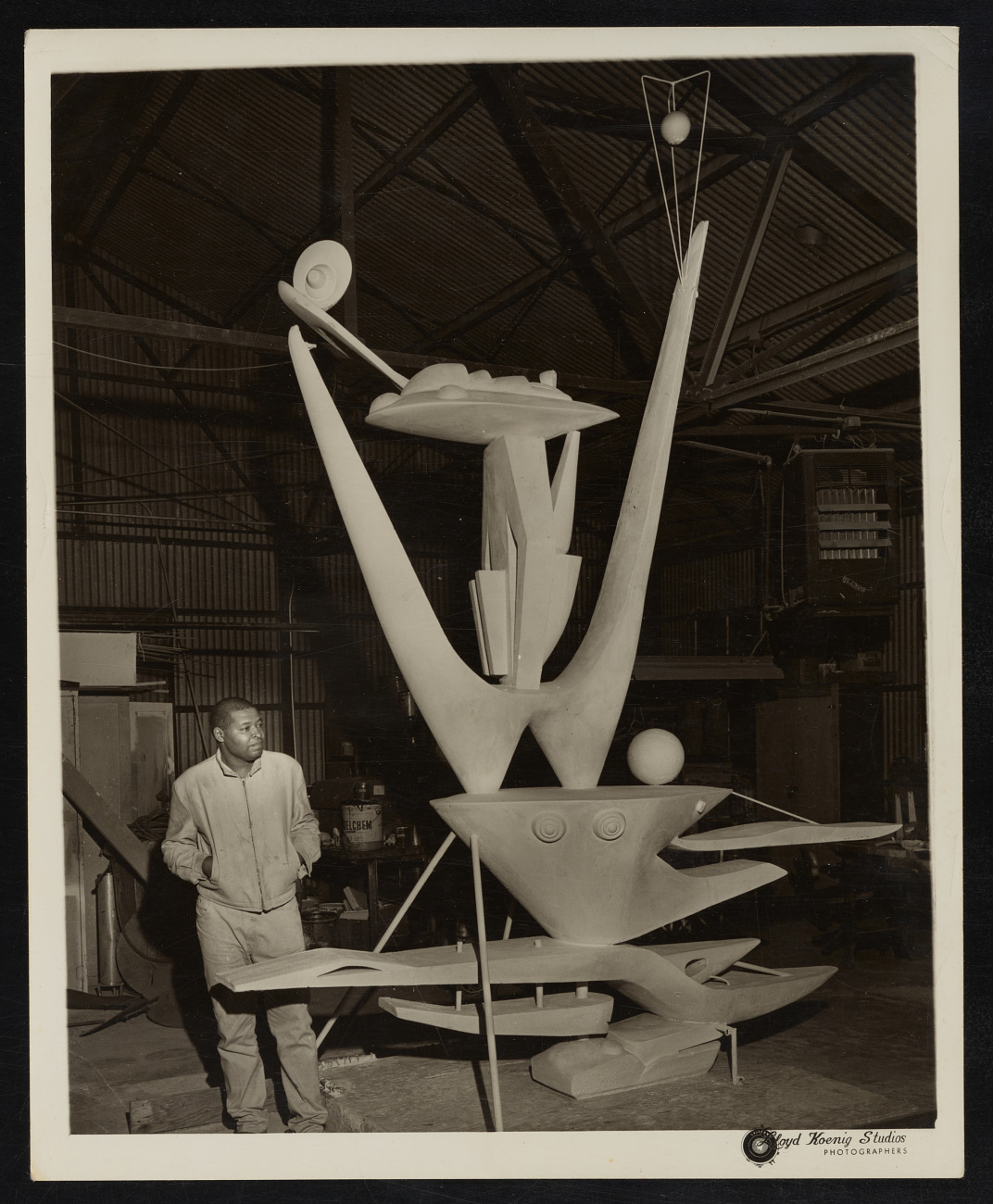
For the Texas Southern University science building, Sims constructed a huge winged aluminum figure that appeared to be moving towards circling planet rings. He described it as a high relief sculpture with conventional geometric and organic forms inspired by certain Negro Spirituals.

Some of Simms’ works were fountains. For example, there is the one titled, “Woman with a Bird,” a 3 ft x 20-inch bronze abstract fountain at the University of Houston; and then there’s “Jonah and the Whale,” a 6-ft bronze.

He also liked to switch it up and express himself through a variety of materials, like stained glass windows in his work titled, “The Doves and the Sacrament,” for a private chapel. He used plexiglass for a mural titled, “Longshoreman,” in Houston. For the Dowling Veterinary Clinic, he created a colorful plexiglass mural of African animals.

One of his major works, “The African Queen Mother,” a 12 ft by 4 ft by 17 ft bronze created in 1968, was composed of symbolic elements from West African folklore. He also designed the circular reflecting pool in front of the Martin Luther King Center of Communications at Texas Southern.

Simms traveled to Nigeria in 1968 to 1969 to experience, for himself, the social and religious significance of African sculpture. He then made another trip in 1973. Here, in Nigeria, he was moved to find that a sociologist, Akinsola A. Akiwowo, of the University of Ibadan and the Nigerian Museum officials didn’t use the word art and instructed Simms to refer to sculpture or pottery as sacred objects or antiquities.

They weren’t called “curators,” they were known as “custodians of tradition and culture” and had the same reverence as priests.

In the 1971 book titled, “African Art,” Frank Willett, another student of William Fagg, does acknowledge the reverence and use of sacred objects but is not so general as to lump all of these objects under the category of sacred.  There were sculptures – for example, brass sculptures that the Dan people created, that were displayed in homes to show off the status of a person or family – as brass was then considered a semi-precious metal.

But maybe these works, weren’t what Simms gravitated to, because he has said, quote, “All of what we call sculpture exist for a purpose. In the United States, we open our King James Bible to find chapter and verses. There when you look at a carving or even at some sacred hill or sacred tree on the landscape you will find the proverbial wisdom of the ancestors.”

Simms identified three major turning points in his development, quote “First the realization of certain permanent values which relate to the integrity of my grandparents inclusive of church folk and neighbors surrounding the environment of my early childhood, second, studies at the Toledo Museum of Art; Hampton Institute; Cranbrook Art Academy and in Africa and Europe third, working at TSU and at the same time being allowed the privilege of creating art for the community.”

Simms was able to see his world poetically and the expression of this world found inspiration from, quote, “As a result of Agriculture: the symphony of folklore – remembering the fable and poetry of the rainbow; the continuity of seasons; the forms shapes and colors of planting and harvest – the carving and tempering of farm tools – quilt making; sewing and embroidery – to wash; to cook; to share in the disciplines of domestic order and during childhood; having learned through worship a reverence for creation: genetically, a search for form and imagery was inspired.”

He retired from teaching in 1987 and returned to England for a new look at the African Collections and work of its sculptors.

One of his deep regrets was that he wasn’t able to set up a foundry at TSU. He said, quote, “I wanted a foundry to teach students how to cast small figures eight or nine inches high so they would understand what their African ancestors achieved centuries ago, but I never got the support to do that and I still regret it.”

Carroll Harris Simms ascended to the ancestors on February 1st, 2010, at the age of 85. Still, his spirit and philosophies lives on through his work, where he found the greatest inspiration through his family who helped nurture a pride for his people. He listened with his heart and eyes to the stories and lessons of his ancestors.

Simms described art as, quote, “The universal spiritual force that makes the dignity, the heritage and origin of Black culture inseparable from all existence.”

Alma Thomas Part II

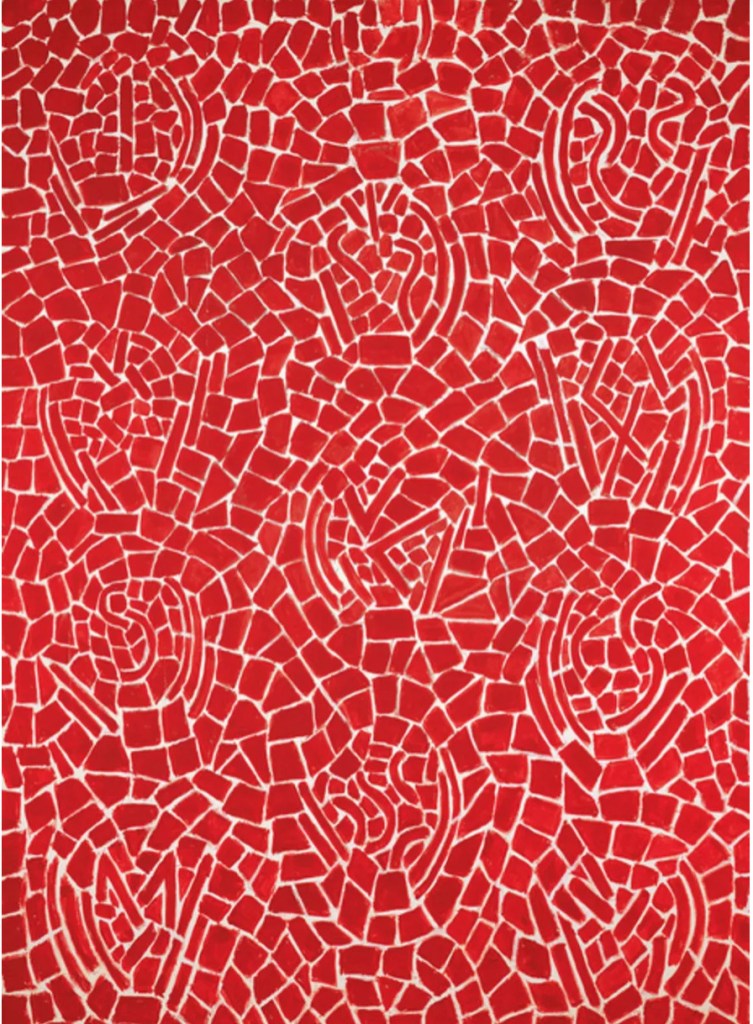
Scarlet Sage Dancing a Whirling Dervish, Alma Thomas, 1976

It was at Howard University, where Alma Thomas met professor James V. Herring. You might remember this professor from our coverage of the artist, curator and scholar, David Driskell. To refresh your memory, James V. Herring, was an artist himself and founded the art department at Howard University in 1922. Remember, Thomas enrolled in Howard University to study costume design in 1921.

Somehow, Herring talked Thomas into giving up costume design and becoming his first student in his brand spanking new art department. Because of her familiarity with the creation of marionettes and making puppet heads, Thomas gravitated to sculpting and created small statues, heads of children, along with some cubist-styled modern works.

She didn’t just sculpt, she also painted, although it’s been noted in the book, “A History of African-American Artists” by Romare Bearden and Harry Henderson, that her paintings at the time weren’t anything special. They were very academic. But what was special about Thomas herself, was that she’d already been teaching for six years by the time she enrolled at Howard, so she wasn’t some doe-eyed unquestioning student. She challenged Herring constantly and I don’t know how he felt about it at the time, but he had at some point come to respect this about her over their continued 50-year relationship.

Bearden and Henderson state that Herring was a very knowledgeable and able professor and held very high standards – now, as an artist myself, I’m not sure what that last part means exactly, having “very high standards.” But then again, I’m not part of art school academia.

So, after graduating, Thomas became an art teacher at Shaw Junior High School in D.C. – the same school she had directed the marionette puppet shows. Now, it’s not clear if she was still doing the marionette shows while studying at Howard or not, but it’s been reported that being an art teacher at Shaw was a job she thoroughly enjoyed.

While teaching, she continued developing her own work and continued to paint – a lot of it in watercolor. Her art skills began to evolve, but were still quite traditional. In 1939, Thomas entered work (I’m not sure which) at the Department of Commerce exhibition and won first prize.

During the summers, when school was out and her time was completely her own, she’d travel to New York to see the major and not so major exhibitions at the MET, the Metropolitan Museum of Art, and other museums in the area.

One day, in 1943, Herring, the same art professor who lured her into his art department and away from costume design, asked Thomas to join him and Alonzo Aden (also a Howard University professor), in creating a gallery – the Barnett-Aden Gallery. According to my favorite source, it was the first private gallery in Washington D.C. to break the color line. Well, Thomas jumped at the chance and became the gallery’s vice-president, deeply involved with discussions about contemporary American art and about which artists to exhibit.

This is when Thomas became entrenched with D.C.’s art circles, other gallery owners, curators and critics. Herring, felt strongly about putting high-quality art front and center, regardless of the race of the artist, regardless of the artist’s notoriety. Of course, with these types of barriers out of the way, it was possible to illustrate how the art of African Americans could stand up in comparison to any other reputable artist.

Thomas was right there when Abstract Expressionism emerged out of the Great Depression and in 1946, Thomas joined the group called, “Little Paris.” This was not a band, this was a group of public-school teachers and government employees who sketched and painted together, critiquing each other’s work. The group was formed by the renowned artist and Howard University professor, Lois Marilou Jones. This group was a cushion of support against the discouragement and dismissal of Black artists that prevailed in the area at the time.

Here, I want to take a moment to say that, it is often reported that Thomas didn’t start her art career until after she retired from teaching in public schools. However, it’s important to point out that Thomas was teaching ART! And before that she was studying and practicing art, which in my school of thought, make her an artist already. If you look at the totality of what she had done before she retired, Thomas was an artist a long time ago! She had already been exhibited in galleries. She was in the Smithsonian… I think it is misleading to start her story by saying that her art career began after she retired. This is just the time she kicked it into a higher gear.

Thomas enrolled at American University in 1950, to study painting with Joe Summerford and Robert Gates. Their work as students fascinated her. According to A History of African-American Artists, Thomas said, “The first time I was there, when they put a still life before me, I tried to paint it just as it was. When I looked in another room… they did not copy anything that was set before them.”

Ben L. Summerford, better known as “Joe,” was born in 1924 in Montgomery, Alabama. Summerford ended up teaching at American University for 38 years. He exhibited all the time in D.C. and also exhibited at the Barnett Aden Gallery where Thomas was vice-president.

Summerford believed that a painting should be constructed of paint. For it was all about color or shape that made painting interesting – not how technical, or realistic it looked.

The other student who inspired her, Robert Gates, was originally from Detroit, Michigan. He also ended up studying then teaching at American University. His watercolors are what first put him on the map.

So, after looking at what these dudes were doing, with all their, out-of-the-box thinking, Thomas began experimenting with abstract elements in her work. This is illustrated in her work titled, “Joe Summerford’s Still Life.” Not only these guys, but she experimented with Cubist elements, like those found in the works of Pablo Picasso and George Braque. If you haven’t heard of Braque, he was a French artist who is credited as one of the developers of Cubism. Check out his work titled, “Violin and Pitcher, 1910.”

At American University, Thomas also studied under Jacob Kainen. He was an expressionist artist and later a curator at the National Museum of American Art.

Source Material:

Alma Thomas – Part I

The Eclipse ,by Alma Thomas, 1970

Alma Woodsy Thomas was born on September 22, 1891, in Columbus, Georgia. Just to give a little context. It’s the year of the Conference of Native American Chiefs at Pine Ridge. The Music Hall in New York (later known as Carnegie Hall) has its grand opening and first public performance, with Peter Tchaikovsky as guest conductor. It’s the year Arthur Conan Doyle‘s detective Sherlock Holmes appears in The Strand Magazine (in London) for the first time. This is 26 years after the Civil War ended.

Alma Thomas was the oldest of six children and was born with impaired hearing. Her mother, Amelia Cantey, said it was because of a scare she and her husband had during her pregnancy. Because of the scary night when a lynch mob came to the house for Amelia’s husband, John Harris, Alma’s father. The mob left them alone, however, when they realized who it was. John Harris wasn’t just anybody, but a big-time businessman, and one of the most respected Black people in Columbus.

The Thomas family lived in a large middle-class home on top of a hill surrounded by trees, gardens and flowers. Education was heavily emphasized in her the family and Alma had aunts that were school teachers who would invite other educators out to Columbus to visit. According to my favorite source, “A History of African-American Artists” by Romare Bearden and Harry Henderson, Booker T. Washington popped in every now and then as well.

In the summers, she spent time at her maternal grandfather’s cotton plantation, which was next to his brother’s plantation, across the river in Alabama – who was White.

Alma’s mama love, loved, loved loved bright colors. And painted flowers on black velvet which was a super popular thing in both America and England. Actually, the tradition of painting on black velvet turns out to be an ancient one. It all started in Kashmir, where the fabric was first made. They started off being religious and painted by priests, but then Marco Polo ended up introducing these paintings to Western Europe. So. There’s that.

Perhaps things would go on like this in Georgia for the Thomas’ for a while longer, but the event that changed the trajectory of everyone in the household was the Atlanta Race Riots of 1906.

By 1900, Atlanta’s population was around 90,000 and 35,000 of those folks were Black. That’s roughly 39%. And for the White Elite, it made them awfully nervous – with job competition and their perception of entitlement and all, they worked diligently to expand upon Jim Crow segregation laws. Especially, those pertaining to seating on public transportation and the segregation of neighborhoods.

Back to Atlanta. So, what really got the White status quo up in arms, was the rise of the Black Elite. The Black Elite were moving and shaking and building and voting… They were educated and connected and respected and… feared. It made some people… uncomfortable.

Now, keep in mind, the Black Elite, in general, was not a big fan of Saloons just like a lot of the White Elite, however, a lot of the White citizens started blaming Black Saloon patrons for the rise in crime.  Prohibitionists in the city were all over that. But, if you know American history then it won’t surprise you that, they were particularly concerned that these saloon goers might commit sexual violence against White women.

But that was not a tool to touch the Black Elite. No. Politics became a tool for that, as the 1906 governor’s race instigated the tension by playing to the fears of White folks, each candidate addressing how to keep, or how they were already keeping, Black folks in their place with disenfranchisement.

In addition to the debates of governor candidates trying to prove the others weren’t oppressive enough to be governor, several local newspapers fanned the flames by printing a plethora of editorials, cartoons and stories about the fears and warnings of the threat of Black men to White women.

 I’m going to give you a super-brief account. Okay? According to the New Georgia Encyclopedia, Saturday, September 22, newspapers in Atlanta reported on four alleged assaults of local Black men against local White women. It’s really important to note here, that none of these reports were ever substantiated. So extra editions were churned out embellishing on these unsubstantiated stories, riling up folks – adding fuel to an already blazing fire. So, then thousands of White men and boys gathered downtown. By evening, the crowd morphed into a mob and then poured out into the streets and began attacking Black people. Hundreds were attacked. The properties of Black-owned businesses were destroyed. Several Black people, men and women, were beaten and killed. The brutality and rioting continued until 2 a.m. when it started storming.

The next day, Black folks began to arm themselves, getting ready for a second wave of attacks. Two days later, on Monday, September 24, a group of heavily armed Black folks held a meeting outside Atlanta and apparently the police found out about the meeting, and was scared that there was about to be a retaliation. The police raided it and a shootout occurred. One policeman was killed. Then three companies of heavily armed militia were dispatched and they disarmed and arrested 250 Black men.

News spread of this event internationally and by the time it reached Alma Thomas’s parents – I know I just went off into the weeds, but remember this is Alma Thomas’s story – her parents were extremely spooked by this. As I’m sure most Black folks were. The event, along with other things, like the quality of education the children were receiving, simmered in their minds, and the next year, in 1907, Mom and Dad packed up the kids and moved to Washington D.C.

Later, Alma Thomas would tell, educator and artist, David Driskell (whose story we’ve covered earlier on this podcast), and said that, before they crossed the Potomac River, their parents told her and her younger sister to take off their shoes and knock off the dust of Georgia, to begin a new life.

Thomas attended Samuel Chapman Armstrong Technical High School, which today is known as Friendship Armstrong Academy, where she excelled at mathematics and science, and had her little heart set on becoming an architect. However, the art room at the high school really got her juices flowing too.

Thomas’s dream of being an architect didn’t seem to pan out, although, at the age of 21, she did create a model of a modern school house that she designed, which was then exhibited at The Smithsonian in 1912.

There may been a bit of a self-esteem issue during, but especially after, high school that prevented Thomas from perusing those earlier dreams. After graduation, she later attended the Miner Teachers College (originally known as, Normal School for Colored Girls – now known as, the University of the District of Columbia).  Here, she experienced feelings of inadequacy. She felt outclassed by girls verbally more expressive than she was, so instead of following her big dream, she studied kindergarten teaching. After leaving College, she then taught arts and crafts for six years at the Thomas Garrett Settlement House in Wilmington, Delaware, making costumes for children’s carnivals and circuses and staging puppet shows.

According to the research in a paper titled, “Black Women in Delaware’s History,” The Garrett Settlement House was named after Harriet Tubman’s friend and fellow conductor on the Underground Railroad, Thomas Garrett. It was founded in 1911 by the City Federation of Colored Women and offered classes to black adults and children, including a kindergarten, as well as recreational activities.

Thomas had an itch to further her education. She knew she had more to offer than what she was doing, so then made the leap to go back to school to get her Master’s degree at Columbia University. She attended their Teachers College, and her thesis was on the use of marionettes. Here, in New York, she studied under Tony Sarg, a renown German American puppeteer and illustrator who was born in Guatemala, who has been credited for modernizing puppetry. Thomas was fascinated by marionettes because they were able to convey so much uninhibited expression.

After receiving her Master’s, Thomas returned and directed several marionette shows at Shaw Junior High School in D.C. Her goal was to open children up to their abilities and stretch their imaginations.

She seem to really love this brand of theater, but her interests reached a little further. Perhaps it was the designing and dressing of her beloved marionettes, or children’s costumes in Delaware, but at some point, she began to play with the idea of venturing further into costume design. And in 1921, Thomas enrolled in school again to study just that. This time, at Howard University.

Source Material:

Robert S. Duncanson – Part III

“The Vale of Cashmere” Robert S. Duncanson

Robert Duncanson had a hard time finishing, “Land of the Lotus Eaters.” It’s hard to focus when your country’s in a civil war, I suppose. He did finally wrap it up and in May, he even exhibited it. You know, it never dawned on me to think about exhibitions happening during the Civil War. I’m gonna go ahead and assume that most folks aren’t thinking about that either.

The exhibition took place in the Pike’s building. Now, this information comes from a big fat book called, “A History of African-American Artists,” but it doesn’t expand upon what the Pike building was or why an exhibition would have taken place there. So, after a little digging, I’m going to infer that the Pike building they’re referring to was actually, Pike’s Opera House. And the reason I believe it might have been exhibited here, is because it was a theater and the building was completed in 1859, just two years before “The Land of the Lotus Eaters,” was completed.  It was an ideal place for new art to be seen by patrons of the arts. Plus, I didn’t find another building by that name. So…

The Cincinnati Weekly Gazette mentioned the exhibition on May 30, 1861, and mentioned that Duncanson’s painting looked a little like Frederick E. Church’s work titled, “Heart of the Andes,” which had been shown earlier in Cincinnati. Did Duncanson bite Church’s work? Mmmm… maybe… a little bit. I can kinda see it. Both works are incredibly beautiful though.

According to the Gazette, the exhibition was scheduled for eight days. Then Duncanson was supposed to exhibit “Land of the Lotus Eaters” and a painting titled, “Western Tornado,” in Canada and then take “Land of the Lotus Eaters” to London to be sold.

Keep in mind, right now, the civil war was happening, and if you thought that a big chunk of this episode would be focused on the civil war because of this time period, you would be wrong. Because we’re talking about Robert S. Duncanson. In 1863, in the middle of the Civil War, he moved to Montreal. He was obviously a lover, not a fighter. I mean, a lover of art, that is. Upon his arrival, he met the photographer, William A. Notman. Notman was a leading photographer in Canada, shooting portraits of prominent national, international and religious leaders. Notman was like J.P. Ball, the renown African American Cincinnati photographer, Duncanson worked with, beginning in 1851 – but on a much bigger scale. Public figures from all over Canada came to his studio and his work won prizes in Europe. Notman took photos of Natives, marketplaces and various social gatherings that gave his work a photojournalistic feel. Duncanson was immediately hired by Notman.

Also, it’s interesting to note, that one of the only known photographs of Duncanson, was taken by Notman. In the photo, you see him sitting in a chair sideways, leaning on a table, with his hat and a cane in one hand. He isn’t looking into the camera. It’s like he’s looking at the floor several feet in front of him, slightly to his right. His hair is parted on one side and his curly hair is slicked over his head in a comb-over. Whatever his hair color, you can tell it isn’t black. He wears an overcoat, and only the top button is fastened.

Outside of working for Notman, Duncanson continued painting local landscapes. In December 1863, Notman published his first volume of photographs, which was made up of forty-four photos of paintings plus two photographs of natural scenes. Of course, it included two of Duncanson’s works – “Land of the Lotus Eaters,” and a new work titled, “City Harbour of Montreal.”

He continued to paint and sell painted local scenes to influential Canadians, who, at the time, were attempting to develop an artistic and cultural life. And when the Art Association of Montreal (which was founded in 1860) opened an exhibition on February 11, 1864, Duncanson, again had the chance to exhibit his prized painting, “Land of the Lotus Eaters,” along with another painting titled, “Prairie Fire.”

Now, I did see a painting titled, “The Prairie Fire,” and that it is estimated to be created around 1850, but I couldn’t find a painting with this specific name, “Prairie Fire” attributed to Duncanson online. The painting I found was on Artsy.net and was from The Blanton Museum of Art. Curiously, there is no artist attributed to this painting… so… I don’t know whose painting this is. I’m not an art authenticator so I can’t say that it’s Duncanson’s.

The art scene was suddenly poppin’ in Canada and on February 27, 1865, The Art Association of Montreal opened another exhibition and this time Duncanson exhibited seven oil paintings and a watercolor among the works of artists like George Inness, J.F. Cropsey and Albert Bierstadt. I don’t have a full list of the eight works he exhibited, but one of them included a work titled, “The Vale of Cashmere.”

He stayed there for a while, in Montreal – and exhibited and taught there and in Toronto. At this point, you might have wondered where his wife has been in all of this. They’re both in Detroit. Duncanson lived in Cincinnati and his wife and youngest son lived in Detroit. I have no idea why.

Then, the summer he exhibited “The Vale of Cashmere,” in 1865, Duncanson finally landed in London – again! It’s assumed that the commissions and exhibitions he landed in Canada, along with the help of his new Canadian network and antislavery organizations in Scotland, helped make this London trip happen.

Sources:

A History of African-American Artists from 1792 to the Present, Bearden and Henderson, 1993, Pantheon, pp. 19 – 39

https://www.artsy.net/artwork/the-prairie-fire

Cleveland Art Museum: https://www.clevelandart.org/art/2014.12

Robert S. Duncanson – Part II

“Blue Hole, Little Miami River,” circa 1851, Robert S. Duncanson

Robert S. Duncanson, fresh and wide-eyed, had only been in Cincinnati for maybe a couple of months when a tense exchange took place in the Summer of 1841 in Cincinnati, in, of all places, a candy shop!

On June 25th, 1841, Cornelius Burnett, a White English immigrant who also happened to be an abolitionist, and owner of a candy store, got into it with a White man from Kentucky and a constable who were trying to arrest a mulatto man, accused of being a fugitive slave hiding out at Burnett’s candy store. The confrontation got physical and Burnet and his son injured both the constable and the White man from Kentucky, who I believe was the supposed owner of the claimed fugitive.

So, the candy store owner, Burnett, and his son, were arrested and held on $3,000 bail. A crowd formed because of this incident. Then, a white mob started breaking windows and threatening nearby houses during the initial confrontation and then another mob formed when the father and son were taken to jail. This mob tried to attack Burnett, but the sheriff had none of that. So, the father and son were safe, for a time. A third mob formed the next day to try to destroy the Burnett property, but this mob was also broken up by the Sheriff. The Burnetts were charged and convicted… of something, what the exact charges were, I’m not sure.

Here is why this incident is important, and why the conflict most likely happened in the first place (I know I’m going off into the weeds a little bit, but stay with me). In May of 1841, remember, the candy store fight took place in June) a judge made an extra-judicial comment on a fugitive slave case that stated that slaves willingly brought to Ohio were technically free because state law didn’t allow slavery. This emboldened some abolitionists in their fight, but it also increased the violence against Black people and abolitionists throughout the state.

But even before Duncanson arrived, African Americans and abolitionists had been suffering violence at the hands of White anti-Black and anti-abolitionist mobs that year. In January, in Dayton, at the court house where an abolition speech was to take place, a White mob threatened the courthouse and rioted for two days, burning down the houses of Black residences. The only ones arrested were the Black people defending themselves. Reading about so much of the violence happening in Ohio in 1841 was very distressing as I was doing the research. Another example – A Black man and a White woman (said to be his wife) were attacked in Cleveland – busting up their house and burning her with coals… In Ripley, two men broke a Black man’s skull, killing him because he had a job that paid him enough to pay off a loan to his mother-in-law who helped buy his freedom from slavery.

According to his dissertation titled, “Community Development for a White City: Race Making; Improvementism and the Cincinnati Race Riots of 1829, 1836 and 1841, by Silas Niobeh Tsaba Crowfoot, multiple stories from newspapers in New Orleans were reprinted in the Cincinnati Gazette, which called for renewed Black oppression through legislation and local customary prejudice behavior. The articles encouraged driving out the free Black people in the area and the harshest treatment for perceived insult on any Black person, free or enslaved.

Of course, reprinting these articles only fanned the flames in an already boiling social climate. And, how would these already hate-filled Cincinnatians feel knowing that the South is now dumping their free Blacks into their yard?

Several incidents occurred in which Black citizens of Cincinnati were accused of all sorts of things, from competing for jobs with White laborers, to jumping out in front of a respectable “White lady” – not assault or robbery or anything… just being there and scaring her, to theft to physical assault. And on top of everything, Southerners were calling the citizens of Cincinnati, “thieves,” for informing their Black citizens of their rights.

Robert S. Duncanson – Part I

Land of the Lotus Eaters, 1861

In doing the research for Duncanson, I had so much juicy information, that instead of trying to cram it all into one episode, I decided to really dig in and give you as much as I could, without going down a rabbit hole. So, unlike the other artists on this podcast, I’ve broken Duncanson’s story into three parts. In this one, of course, I’d like to cover his earliest years – Please note, though, that I won’t go too early because there’s not a lot of information on his childhood.

In the second part, I’d like to cover Duncanson’s life and work leading up to the Civil War and in the final part, I’ll wrap it up with his journey’s end. The end, at least on this plane. Also, because I’ve read different things about Duncanson’s life, accounts are written in a way that may, on the surface conflict with mine, I need to say upfront, that a lot of my source material comes from the 1993 book titled, “A History of African-American Artists: From 1792 to the present,” by the fine artist Romare Bearden and journalist, Harry Henderson. Because I actually know who the authors of this book are as well as their methods of research, I’m tend to trust their information.

Okay, so, Robert Scott Duncanson was born in 1823, in Seneca County, in New York. His mother was a Black woman from Cincinnati who most likely ran off to Canada, because, why not? Being a free Black woman in the 1800s was still hard. Keep in mind, Robert Duncanson was born almost 40 years before the Civil War, so, though Ohio was a free state, it was right at the edge of slaveholding states. The existence of slavery was felt everywhere, not just in slaveholding states. And when I say it was “felt” – I probably don’t have to explain this, but – I’m saying African Americans felt this. Even the free ones.

Duncanson’s father was a Canadian of Scottish decent. Not much is known about him. What is known, is that at some point his mother and father separated. And I know this is not a big part of the telling of Duncanson’s story, but I did wish I knew why. It’s kind of like when celebrities break up… sometimes you want to know why… Anyway… His mother left her son in the care of his father. At what age? We don’t know. But his mother went back to Cincinnati to be with her family.

Now, growing up in Canada meant that Duncanson was educated through the Canadian public school system, which was said to be top notch at the time, especially when you compare it to the education Black school children were receiving (and weren’t allowed to receive) in the U.S. There’s absolutely no comparison!  So, with this excellent education he developed this passion for literature – English literature in particular. This love of literature would be the source of inspiration for many of Duncanson’s future works.

In 1841, so when he was around eighteen, Duncanson packed up and left Canada to go live with his mom in Cincinnati. Not really sure what happened there – whether his father passed away or if he just missed his mom, or was seeking some type of opportunity his mom had told him about in Ohio, but he did join her. Now, they must have been pretty close since, a Black man leaving Canada to come and live in a state at the dangerous edge of slavery is kind of unheard of.  Then again, he did grow up in Canada. And he was very young. His perspective is going to be a little… different.

It might’ve been Cincinnati’s art scene that took him out there. He most likely was aware of his own artistic talents before he left. And Cincinnati had about a hundred artists in the city, and they’d had art schools there since the 1800s. Still, Cincinnati, though a free state was influenced heavily by slaveholders. “They considered it a southern town on free soil.” However, it was a station on the Underground Railroad.

Just to remind you, the Underground Railroad was a secret network of individuals and safehouses to assist other people escaping slavery.

So, let’s talk a little about Cincinnati. At the time, the city’s leaders wanted Cincinnati to be this great cultured community. I read that they were calling themselves “The Queen City of the West.” So, I’m not sure if anyone else was calling them that… also, I don’t know who “The Queen City of the East” is either… But city leaders, including Nicholas Longworth, who made his money through law, banking, real estate and wine, wanted to compete with the sophistication of eastern cities so they pushed for the city to build like crazy – colleges; an opera house; law and medical schools; observatories and other scientific institutions.

Cincinnati was interesting because several cultural influences were melting into the city. There were the East Coast business men; there were European immigrants looking to create a new life; there were Western hunters and Rivermen.

By the way, I looked up what Rivermen were, because I wanted to find out if we should be calling them “river people.” I’d never heard of rivermen before, but the word sounded self-explanatory, but… you never know. So, when I did my initial research, the first thing I came across was the professional hockey team, the Peoria Rivermen.  I saw their logo and was pretty certain of what I’d find. Digging slightly deeper, I confirmed that Rivermen were pretty much what they sounded like – people who worked on or along the river. Because of the time period, I can safely assume that these were mostly men working on the river but I can’t speak on any women who joined them… so… rivermen.

In Cincinnati, there were also both free Black citizens and White Southerners. There were planters. There were those who stole themselves and ran from slave owners and there were slave hunters.

There were about 3,000 Black people in Cincinnati by the time Duncanson arrived and the majority of them were former slaves.  Which was a huge concentration of free Black folks – among the largest in the U.S. at the time. Not only were they free, but were rather industrious as well, owning their own stuff. Their own property, their own stores, schools, churches, hotels and places to cut loose and entertain themselves.

There were leaders like John I Gains, an abolitionist and advocate for African American education. There was Robert J. Harlan, an entrepreneur, civil rights activist and politician. There was Peter H. Clark, an abolitionist, writer, publisher and orator. These men along with other Black leaders were highly respected and were instrumental in hiding fugitive slaves that crossed the Ohio River into freedom every night.

Like Duncanson, many Cincinnati artists were self-taught. What was popular then, were to paint portraits and panoramas. Panoramas were these huge panels of canvas, like eight feet high and they were rolled up on a giant vertical spool and slowly unreeled on a stage to reveal these epic scenes while a narrator described the scenery to a captive audience. The scenes were images of specific sights, like Niagara Falls or what could typically be seen on a trip down the Mississippi River. There were panoramas that even retold stories from the Bible and American history. Some depicted slave life. This was both educational and entertaining and the public ate it up! Loved it!

Outside of portraiture and panoramas, there were also a group of Cincinnati artists who gravitated to the beauty of the wilderness and turned to landscape painting with its transcendence of man’s daily grind and the wastefulness of civilization, to the deep spiritual connection to the wild. “God’s work.” So, landscape artists were also pulled into the panorama scene to create many of the epic landscapes to tell these stories.

In this city, Black artists were allowed to participate in the local art scene – somewhat – and gain recognition to their contributions to The Hudson River School of landscape painting. To be clear, The Hudson River School was not an actual school, just like the Underground Railroad was not an actual Railroad. Don’t let Colson Whitehead’s book fool you (although it’s really good! You should totally read it if you haven’t already – it’s called “The Underground Railroad” – I haven’t seen the movie so I can’t speak on that – but the book – amazing!).

So, no. The Hudson River School was an American art movement practiced by a group of landscape painters that explored three elements discovery, exploration and settlement – but approached in a dreamlike –romanticized way. The name comes from the fact that these paintings were usually of the Hudson River Valley and surrounding areas.

Remember, I said Black artists could participate – somewhat. They could… but… it was hard. I want you to imagine this city with its combination of abolitionists and free Black people and Southern plantation workers that controlled the city’s finances. Are you thinking about it?  There were three riots incited by Southern plantation owners in Cincinnati against the city’s Black citizens and abolitionists. In 1823, in 1836 and in 1841. The year Duncanson arrived.

Duncanson came in the spring of 1841 and joined his mother in her cottage on Hamilton Avenue in the village of Mount Pleasant (later renamed Mount Healthy because of the survival rate of its fortunate residents after the 1850 cholera epidemic – the village later became a city in 1951).

Then Duncanson, met a girl that caught his eye – or he caught hers, I don’t know which – and then got hitched! According to some sources his new bride had escaped slavery. They had a son named Reuben. At some point, poor Reuben dies, and it’s not clear from what or at what age, but he does make it to at least 18 because his dad helps him find a job as a clerk.

Back to his arrival. Duncanson is different. He’s a different kind of Black man. He was educated in Canadian public schools and didn’t suffer the constant harassment most African Americans did as children. He didn’t have the apprehension and inhibitions most African Americans did. He was sociable with everyone! He was good-humored. He was modest, but ambitious. And he had no qualms about declaring his intention of becoming a professional artist. That was crazy! No African Americans did that!

Then, in September 1841… remember that last riot I told you about? Yeah. That happened.

Langston Hughes: A brief history and a story

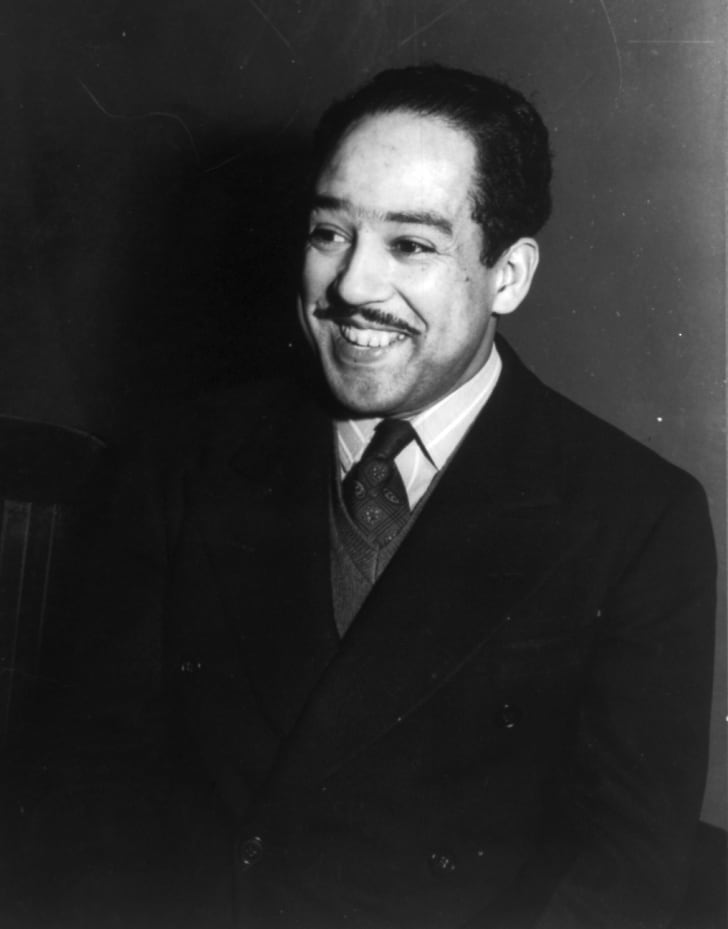
Langston Hughes was born, James Mercer Langston Hughes on February 1, 1902, in Joplin Missouri. He was partially named after his grandfather, John Mercer Langston, a free born attorney, abolitionist and politician and the founding dean of Howard University’s law school.

Hughes had a complicated upbringing, his dad left the family shortly after his birth and his mother left to go find work, which left him in the care of his maternal grandmother. It’s his grandmother who instilled Black pride in him and introduced him to the worlds inside of books where he’d happily lose himself. After the passing of his grandmother, he reunited with his mother who had remarried in Ohio, where he graduated from high school.

He briefly lived with his father in Mexico, but Hughes came back to the states after about a year and then attended Columbia University, but dropped out in 1922 because the racism among students and teachers there was just too much. After that he worked odd jobs. One was as a crewman for six months on the S.S. Malone where he got the chance to visit West Africa and Europe.

Hughes stayed in Paris for a short while where he met and engaged in a love affair with Anne Marie Coussey, a well-off Ghanaian woman, who was educated in England and was the sister of James Coussey, a judge of the Supreme Court of the Gold Coast. Her family didn’t approve of the pair and a friend of her father was sent to Paris to put an end to the love affair with Hughes.

By 1924, Hughes was back in the U.S., and in 1925, became the personal assistant to Carter G. Woodson at the Association for the Study of African American Life and History – though back then, it was called, the Association for the Study of Negro Life and History. Eventually, Hughes returned to school and attended Lincoln University and by 1929, received his B.A.   By the way, one of his classmates was Thurgood Marshall – the first African American Supreme Court Justice.

Hughes returned to New York.  Throughout his life, Hughes was a prolific writer. He wrote volumes of poetry and was published in newspapers and magazines, including a publication called, “The Crisis,” the official magazine for the NAACP in 1921, while still at Columbia. His first volume of poetry was published in 1926, titled, “The Weary Blues.” In 1930, his first novel, “Not Without Laughter,” won the Harmon Gold Medal for literature. In 1937, he traveled to Spain as a correspondent for the Baltimore Afro-American. In 1953 he was called before the Senate Permanent Subcommittee on Investigations to deem whether or not he was a communist.

Of course, all that I’ve just told you is just the tip of the iceberg of what Hughes has accomplished. What I’ve given you is a very brief overview. Think of it more as an abstract. I didn’t even tell you about the Verve recording of his poems he performed with Thelonious Monk and Leonard Feather (the jazz-poetry you heard at the top of the episode).

Langston Hughes died on May 22, 1967, at the age of 66 after an abdominal surgery. His ashes lie beneath a floor medallion in the foyer of the Schomburg Center for Research in Black Culture in Harlem.

Now that you’ve heard a tiny bit about who he is and what he’s done, I’ll read one of Hughes’ short stories titled, “Thank You, Ma’am” found in an anthology edited by Hughes, titled, The Best Short Stories by Black Writers, published in 1967.

Louis Delsarte: The People’s Painter

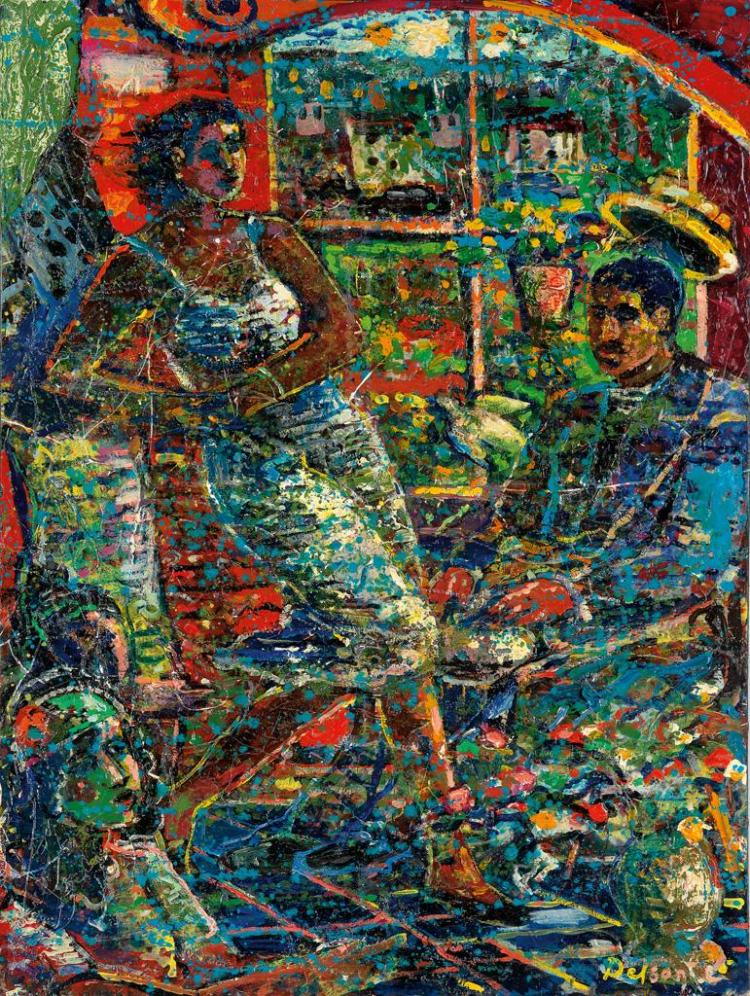
Congas de Cuba
Louis Delsarte

According to the Louis Delsarte website, Delsarte’s parents were friends with artists and entertainers from the Harlem Renaissance like Lena Horne, Count Basie, Duke Ellington and Langston Hughes. Back then, it wasn’t called the Harlem Renaissance, it was called, “The New Negro Movement,” after the 1925 anthology edited by Alaine Locke titled, “The New Negro.” He was exposed to jazz, operas, musicals and the blues. This early exposure to various artistic expressions and practitioners of these expressions would leave its imprint on Delsarte and later influence his voice as an artist.

Sources:

“Louis Delsarte: A painter for the people,” May 8, 2020, Shelia Poole, The Atlanta Journal-Constitution

https://www.louisdelsarte.net/about

“How 9 Artists Keep Their Creativity Alive,” Time.com

HammondsHouseMuseum.com

Arturolindsay.com

David C. Driskell – Part II

Pines 1973 – Driskell

David C. Driskell – Part II

This is Part II of the two part series on David C. Driskell. I’ve listed my sources for the last two episodes below.

Also, when you get a chance, watch the HBO documentary titled, “Black Art: In the Absence of Light.” It’s based upon one of Driskell’s major exhibitions he organized and curated.

Sources:

  1.  Genzlinger, Neil (April 7, 2020). “David Driskell, 88, Pivotal Champion of African-American Art, Dies“. New York Times. Retrieved April 9, 2020. Print version, April 9, 2020, p. B12.
  2. “David Driskell – Artists – DC Moore Gallery”. www.dcmooregallery.com. Retrieved 2020-07-18.
  3. McGee, Julie L. ( 2006). David C. Driskell: Artist and Scholar. San Francisco: Pomegranate Communications. ISBN 0764937472.
  4. Barnes, Bart (April 3, 2020). “David Driskell, advocate for African American art, dies at 88 of coronavirus”. The Washington Post. Retrieved April 4, 2020.
  5. Crawford, Amy. “A New Retrospective of David Driskell, Artist and Scholar of African American Art, Comes to Atlanta”. Smithsonian Magazine. Retrieved 2021-01-18.
  6. “Two Centuries of Black American Art”. LACMA. Retrieved 2021-01-18.
  7. “David Driskell: Icons of Nature and History”. High Museum of Art. Retrieved 2021-01-18.
  8. ^ “Coming Soon: ‘Icons of Nature and History,’ a Major Survey of David Driskell Opens at High Museum in Atlanta in February 2021”. Retrieved 2021-01-18.